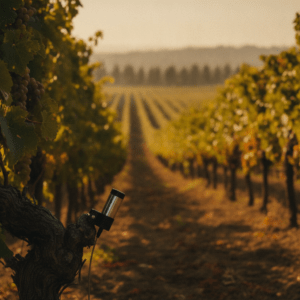

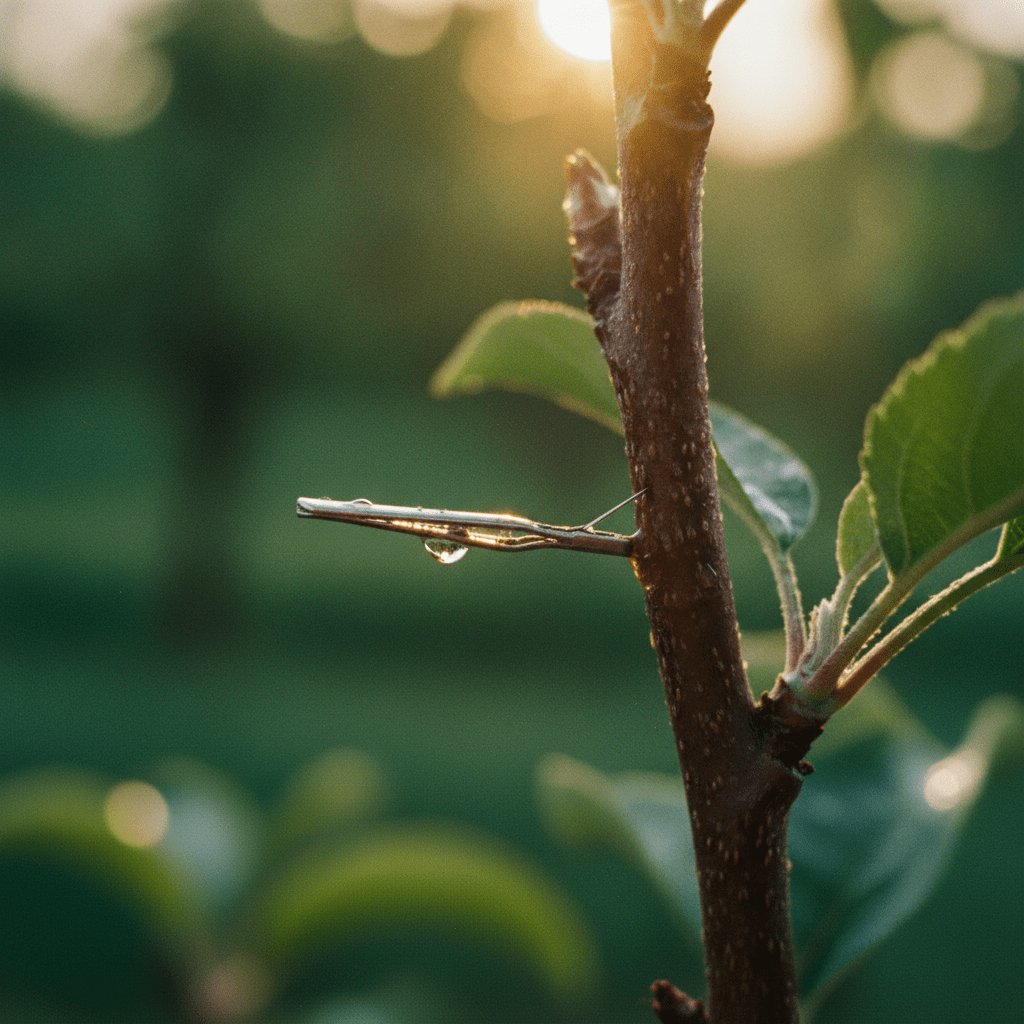
A sap flow sensor measures how much water is moving up through a plant’s stem at any given moment, giving you a direct, real-time reading of what the crop is actually drinking. Because nearly all the water a tree or vine absorbs eventually leaves through the leaves as transpiration, tracking that upward stream tells you whether the plant is comfortably supplied or starting to close down under stress, often before a single leaf shows it.
That is a different question from the one most farm technology answers. Weather stations tell you what the atmosphere is demanding. Soil probes tell you what water is available in the ground. Neither tells you what the plant is doing with it. This guide is written for the orchard or vineyard manager and the agronomist who are weighing up sensing technology and want to understand, honestly, what stem sap flow measurement delivers and where its limits are.
What is a sap flow sensor and how does it work?
A sap flow sensor estimates the rate at which sap travels through the water-conducting tissue (the xylem) of a stem, branch or trunk. Almost every commercial design works with heat, because moving sap carries heat with it. Insert a small heat source into the wood, place temperature probes around it, and the way that heat spreads (or gets swept away) tells you how fast the sap is flowing.
From a slow trickle at night to a fast current on a hot, windy afternoon, that flow rises and falls with the plant’s water demand. Read continuously, a sap flow sensor turns an invisible internal process into a curve you can act on: high flow means the plant is transpiring freely and finding the water it needs; a flattened or suppressed curve during peak daylight is an early warning that the roots can no longer keep up.
The physics has been field-tested for decades. Granier’s thermal dissipation method, first validated in a forest stand in the 1980s, established the empirical relationship between a heated probe’s temperature and sap flux density that most modern instruments still build on (Granier, Tree Physiology, 1987). What has changed is the packaging: from bulky research rigs to compact, plant-friendly sensors built for a working farm.
Which sap flow measurement method is right for you?
There is no single “sap flow sensor.” Several heat-based techniques exist, and they trade off cost, accuracy and the size of stem they suit. Understanding the differences helps you read any vendor’s specifications critically.
| Method | What it measures | Strengths | Trade-offs |
|---|---|---|---|
| Thermal dissipation (Granier / TDP) | Sap flux density from a continuously heated probe | Simple, low cost, well documented, good on larger trunks | Can underread at very low flow; needs sapwood-area correction |
| Heat-pulse (compensation / heat-ratio) | Speed of a short heat pulse moving with the sap | Handles low and even reverse flow; low power draw | Point measurements need scaling; probe alignment matters |
| Stem heat-balance | Heat carried away by sap around a wrapped stem section | No probes inserted; suits small stems and herbaceous plants | Best on thin stems; sensitive to insulation and ambient heat |
The practical takeaway: thermal dissipation and heat-pulse systems dominate in orchards and vineyards, while heat-balance gauges are common for young or thin-stemmed plants. Whichever method a transpiration sensor uses, the value is the same, a continuous, plant-level signal of water movement rather than a snapshot of the plant’s surroundings.
What can plant water-use monitoring tell you that soil sensors can’t?
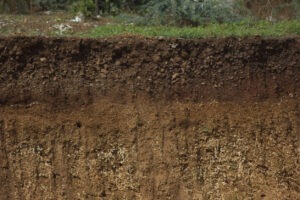
Soil moisture is genuinely useful, but it is one step removed from the plant. Water can be present in the ground and still be hard for roots to extract, because of salinity, compaction, cold soil or a shallow, damaged root system. Plant water-use monitoring closes that gap by reading the response, not the resource.
A few things a sap-based signal surfaces that a soil probe cannot:
- Real uptake, not just availability. Sap flow shows whether the plant is drinking the water you applied, the ultimate test of whether an irrigation worked.
- Early stress, not late symptoms. Studies of water stress consistently find that stomata start closing and flow slows well before wilting or leaf change is visible to the eye.
- The plant’s own threshold. Two blocks with identical soil moisture can transpire very differently by variety, rootstock and canopy size.
- Response to each irrigation. You can see the flow curve recover (or fail to) after you open the valves, turning every cycle into feedback.
The honest limit: sap flow tells you that the plant is under water stress and roughly how hard, but on its own it does not tell you why. Pairing it with soil and weather data (the availability and the demand around the plant) is what turns a signal into a diagnosis. If you want the wider picture of catching problems early, see our guide to detecting water stress before symptoms appear.
Where does a stem sap flow sensor fit in your irrigation decisions?
This is where measurement becomes management. A precise delivery system (drip in particular) controls exactly how much water reaches the root zone, but it cannot decide when the plant needs it. That decision has traditionally rested on the calendar, the forecast or a soil reading. A stem sap flow sensor lets the plant weigh in directly: irrigate when its water use signals demand, and hold back when the flow curve shows it is already satisfied.
The result is fewer wasted cycles without the risk of quietly starving the crop. It pairs naturally with any efficient delivery method, if you are still choosing between systems, our comparison of sprinkler versus drip irrigation covers that ground. Sap-based scheduling doesn’t replace your irrigation hardware; it tells that hardware when to act.
This is the differentiator behind Plantvoice. Rather than reading the plant’s environment from the outside, our patented micro-sensor sits inside the stem and reads the sap directly (both its flow and its salinity) so the signal comes from the crop itself, not from a proxy nearby. The app turns those readings into a plain recommendation: water now, or wait. Being honest about scope matters here: a sensor on a few representative plants per homogeneous zone reads that block, not every individual tree, and it works best alongside soil and weather inputs. Used that way, growers combining sap-based scheduling with drip have cut irrigation water by up to 40% while protecting fruit quality.
How do you get started with sap flow sensing?
You don’t instrument the whole farm on day one. A workable path looks like this:
- Map your zones. Group the plot by soil type, variety and age; a few monitored plants per zone represent the block.
- Fit the sensors on representative plants. With a stem-inserted design, you place them yourself, no external technician required.
- Set stress thresholds with an agronomist. Alert levels depend on crop, growth stage and season; fruit set is not veraison.
- Irrigate on the signal. Open the valves when sap flow indicates demand; skip the cycle when it doesn’t.
- Review and refine. Watch how flow recovers after each irrigation and adjust the thresholds over the season.
For the broader monitoring picture beyond water, see our companion guide to continuous plant health monitoring. If you want the underlying method in depth, the PROMETHEUS plant-physiology protocols document the main sap flow techniques and their calibration (PROMETHEUS: Sap flow).
FAQ
What does a sap flow sensor measure? It measures the rate at which sap moves up through a plant’s stem, which closely tracks transpiration and therefore the plant’s real-time water use. Read continuously, it shows when a crop is drinking freely and when it is slowing under water stress.
Is a sap flow sensor better than a soil moisture sensor? They answer different questions. Soil sensors show how much water is available in the ground; a sap flow sensor shows how much the plant is actually taking up. Used together, they give both the resource and the plant’s response, which is far more reliable than either alone.
Can a sap flow sensor detect water stress early? Yes. Sap flow slows when stomata begin to close, which typically happens before wilting or leaf symptoms are visible. That lead time is the main reason growers use plant water-use monitoring for irrigation scheduling.
How many sap flow sensors do I need per field? You don’t instrument every plant. A few representative plants per homogeneous zone (grouped by soil, variety and growth stage) are usually enough to read the behavior of the whole block.
Does a sap flow sensor tell me exactly how much to irrigate? It tells you whether the plant needs water and how hard it is working, which sets the timing of irrigation. To convert that into a precise volume, you combine the sap signal with soil moisture and weather data and calibrate thresholds with an agronomist.
Ready to hear what your plants are telling you? A sap flow sensor turns guesswork into a signal you can act on. Talk to our agronomists to see how stem-based monitoring fits your orchard or vineyard.