The use of insecticides In agriculture, it is currently governed by stringent regulations that require mandatory integrated pest management. This article provides an operational guide: when to intervene according to verified thresholds, how to choose the active ingredient, which application techniques to adopt to reduce drift and environmental impact, and how to manage wastewater and containers according to the law. We will also examine decision support systems (DSS) and validated biological alternatives to reduce the use of chemicals without compromising crop protection.
Reducing chemicals through preventive monitoring
The application of the Legislative Decree. 150/2012 and the National Action Plan (NAP) have radically changed the approach to insecticide use in agriculture. Since 2014, integrated pest management has been mandatory for all professional users: this means that synthetic chemical insecticides are no longer the first choice, but the last resort after agronomic, physical, and biological resources have proven inadequate.
Constant monitoring of pest populations allows intervention only when economic damage thresholds are actually exceeded, reducing the number of treatments compared to scheduled strategies. However, achieving these results requires specific skills and a shift in operational mindset.
When insecticide is really necessary
The decision to apply an insecticide must be based on objective data , not on perceptions or seasonal routines. Decision Support Systems (DSS) integrate meteorological data such as temperature, humidity, and rainfall with mathematical models of insect development to predict critical events such as egg hatching, larval development, adult flight peaks, and the optimal times for application. Using economic damage thresholds as the central criterion , DSS allow targeted treatments to be planned only when truly necessary . Each crop and each insect has specific thresholds , defined by agronomic research, which represent the level of infestation beyond which the economic damage exceeds the cost of treatment . Ignoring these thresholds and treating preemptively without objective checks generates negative consequences: wasted money due to product costs and application time, selection of resistant populations, elimination of beneficial insects such as predators and parasitoids, and accumulation of residues beyond permitted limits.
Types of insecticides: impact and selectivity
Not all insecticides have the same risk profile. The choice must consider not only the efficacy on the target, but also the impact on non-target organisms and the environment.
| Category | Mechanism of action | Selectivity | Persistence | Operational notes |
| Pyrethroids | Neurotoxic (sodium channels) | Low | 1-2 days (air/water), persistent in sediments | Highly toxic to aquatic organisms and bees, high risk of drift |
| Neonicotinoids | Neurotoxic (nicotinic receptors) | Average | 100-1000+ days in soil | Severely restricted use to protect pollinators, banned in the EU since 2018 |
| Organophosphates | Acetylcholinesterase inhibitor | Low | 5-10 days | Being phased out, high toxicity for the operator |
The problem of resistances
Repeated use of insecticides With the same mechanism of action, it selects resistant populations . The Insecticide Resistance Action Committee (IRAC) classifies active ingredients into numbered groups: it is essential to alternate different groups throughout the season. The correct choice of active ingredient is only the first step: the application method is equally critical to avoid environmental contamination.
Drift reduction: mandatory technical measures
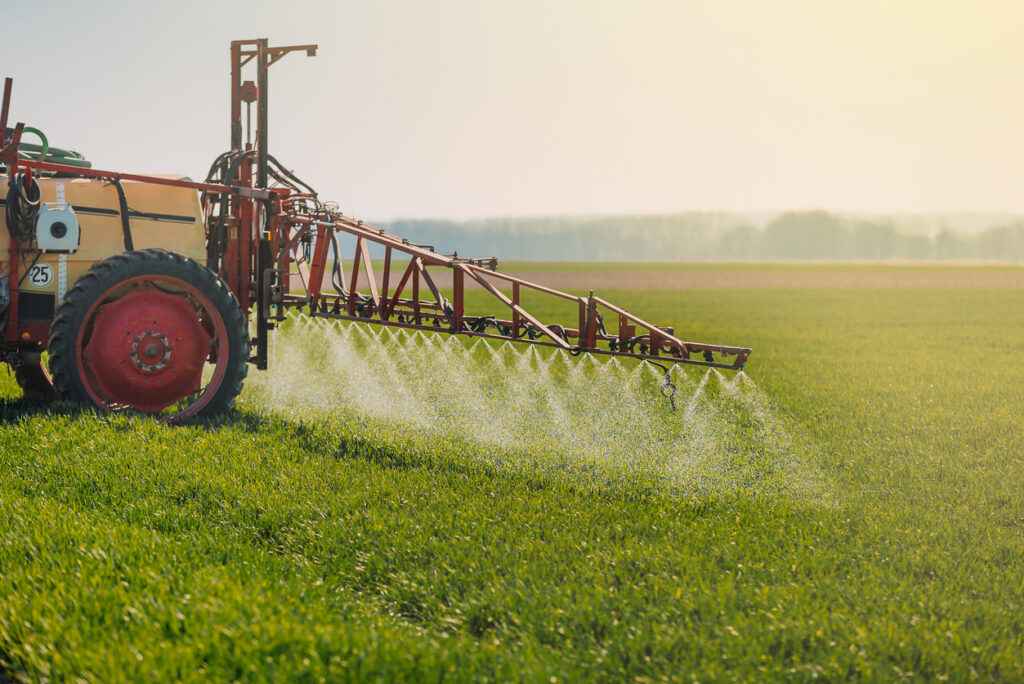
Drift represents one of the most critical environmental risks in insecticide application. It occurs when product droplets are transported by the wind outside the target area , settling on soil, vegetation, and especially bodies of water, constituting the main cause of point-source contamination of surface water . For this reason, the National Action Plan and regional guidelines require specific mitigation measures regarding both minimum distances from bodies of water and operating conditions during treatment.
Buffer zones , or untreated distances from bodies of water, vary based on the product’s potential danger to aquatic organisms . For highly toxic products, these distances can reach 30 meters in the absence of drift reduction systems, while in vulnerable areas, there is an absolute ban on spraying in buffer zones. The use of certified anti-drift nozzles , particularly air-injection nozzles that produce larger droplets by reducing the fine particles easily dispersed by the wind, allows for the reduction of buffer zones on some crops while maintaining the same environmental protection effectiveness.
Weather conditions during application are equally crucial. It is forbidden to spray with winds exceeding 3 meters per second (about 10 km/h), as higher speeds dramatically increase drift, carrying droplets even tens of meters away. Monitoring operating conditions must be performed with specific instruments such as an anemometer, thermometer, and hygrometer, never relying solely on perception, and all parameters measured must be recorded in the field logbook as documentation of the correct execution of the treatment.
Monitoring: the basis of reduction
Monitoring is the cornerstone of mandatory integrated pest management . Without field data, it’s impossible to justify insecticide application according to the NAP. Here are the main monitoring tools:
– Sexual pheromone traps: specifically designed for Lepidoptera (moths, cutworms, and corn borers), they allow for weekly catch counts correlated with egg-laying risk. Predictive models calculate heat accumulation to estimate larval development and identify critical intervention times.
– Color traps: colored panels attract specific insects (yellow for aphids, whiteflies, and agromyzids; blue for thrips). Counts should be performed every 3-7 days based on expected pressure and allow population trends to be monitored.
– Direct sampling: visual inspection of representative plants or organs to count larvae, adults, and damage. Essential for insects not attracted to traps and to assess the actual infestation status before deciding on intervention.
Application techniques to maximize effectiveness
Correct application of insecticide It represents a central component. The right distribution technique is an integral part of sustainable use and requires attention to three fundamental parameters :
- Spray volume: must ensure uniform coverage of the vegetation, not saturation. Excessive volumes do not improve effectiveness but increase drift, runoff, operating costs, and return to the field time, as well as promoting product percolation into the soil, resulting in waste.
- Droplet size and coverage: This directly affects both efficacy and environmental risk. Fine droplets, with a diameter of less than 150 micrometers , offer good leaf surface coverage but are highly susceptible to drift and should only be used in optimal weather conditions. Medium droplets, between 150 and 300 micrometers , represent the best compromise for most insecticide applications: they guarantee acceptable coverage while keeping drift under control. Coarse droplets, over 300 micrometers , minimize the risk of drift but offer less coverage and require higher operating pressures. The choice of nozzle must reflect the type of application required.
| Drop size | Ideal application | Characteristics |
| End (< 150 μm) | Systemic insecticides, foliar treatments | High risk of drift |
| Medium (150-300 μm) | Contact insecticides, majority of uses | Coverage/Drift Compromise |
| Big (> 300 μm) | Soil weed control, penetrating products | Low drift, pressure needed |
- Timing: Insecticides are most effective against young stages. Treating adults or mature larvae requires higher doses with lower efficacy.
Treatment waste management
The sustainable use of insecticides It doesn’t stop at application: proper management of washing wastewater and empty containers is essential to avoid environmental contamination . After each treatment, the sprayer must be washed, and the wash water contains insecticide residues . This water cannot be discharged into ditches, drains, waterways, sewers, or on uncultivated land: it would be a serious source of point contamination. There are two main correct solutions:
- Dilute the wastewater by distributing it over the same crop just treated .
- Use biological purification systems , which degrade waste.
Empty product containers are classified as special waste and require specific management . Before disposal, they must be rinsed repeatedly (or pressure washed), and the washing liquid added to the mixture during treatment preparation, thus recovering the residual product. After rinsing, the containers must be stored in a dedicated covered area.
Biological alternatives to reduce synthetic chemicals
Mandatory integrated pest management requires giving priority to methods with the lowest environmental impact :
- Agronomic prevention through varietal choice and crop rotation.
- Monitoring , to intervene only when thresholds are exceeded.
- Introduction of beneficial insects (parasitoids and predators).
- Mating confusion techniques against Lepidoptera.
- Use of biological control agents such as Bacillus thuringiensis or entomopathogenic viruses .
The use of synthetic insecticides is justified only when these methods are insufficient , while favouring the most selective products.
Functional inspection of sprayers: requirements and benefits
Functional inspections of sprayers are mandatory and must be performed at centers authorized by the Region . The interval between inspections must not exceed five years , a requirement established to ensure that the equipment maintains safety and efficiency standards over time. The inspection assesses the proper functioning of all components through standardized tests performed with specific equipment and protocols : transmission elements, pump, tank, agitation system, measurement, control, and regulation systems are inspected. Machines found to be non-compliant must be repaired and re-inspected before they can be used.
Having a functional and correctly adjusted sprayer is an operational necessity with several advantages:
- It helps avoid inappropriate environmental pollution caused by leaks, drips or uneven distribution of the product.
- Increases operator safety by reducing the risk of accidental exposure during use.
- It generates considerable economic savings both on the plant protection product, avoiding waste due to malfunctions, and on the volumes of water used thanks to more efficient distribution.
Calibration and routine maintenance are essential for maintaining application efficiency between mandatory checks, but they are no substitute for inspection by an authorized center using standardized protocols and certified equipment.
Mandatory training: qualification and updating
The purchase and professional use of plant protection products, including insecticides, requires possession of a qualification certificate that replaced the old “green license.” The certificate is obtained by attending a 20-hour training course followed by a final exam . It is valid for five years , after which a 12-hour refresher course is mandatory for renewal. Course attendance must be at least 75% of the total hours and must be proven by a certificate.
Reference sources for professionals
To operate correctly in plant protection, it is essential to know the official reference sources . The SIAN (National Agricultural Information System) plant protection product database allows you to verify authorized products and their characteristics.
The Regions annually develop Integrated Production Regulations , which include agronomic and pest management techniques for various crops , with binding indications on the active ingredients that can be used and the frequency of interventions. Compliance with these regulations is required to access the measures provided for by the Rural Development Programme.
FAQ – Frequently Asked Questions
- Can I use an approved insecticide on a crop other than the one on the label?
No, the Legislative Decree 150/2012 It establishes that each plant protection product is authorized for specific crop-pest combinations indicated on the label. Use outside of the label’s instructions constitutes a violation of current legislation and entails the user’s liability for any consequences on health, the environment, and the quality of produce.
- What personal protective equipment is mandatory during treatments?
The Safety Data Sheet (SDS) for each product indicates the specific personal protective equipment (PPE) required . It is mandatory to wear PPE before handling product packaging and to keep it on throughout the entire mixing process, during processing, and when cleaning equipment. PPE should be removed gradually, avoiding contact with unprotected body parts, and should be stored clean in an easily accessible place.
- When can workers return to the field after insecticide treatment?
For some products, the re-entry time is explicitly indicated on the label or safety data sheet , generally expressed in hours. For products that do not include this indication, it is necessary to wait until the vegetation is dry , and in any case no less than 24 hours, before allowing workers to return without protective equipment, especially for operations involving direct contact with vegetation, such as pruning, thinning, or shoot removal.
Monitoring is the first step in sustainable integrated pest management. Plantvoice helps you collect real-time field data to decide when and how to intervene.