

In the world of professional botany, having reliable tools for plant monitoring is essential. PlantVoice is presented as an innovative app for any botanist, designed to facilitate the observation, analysis and management of plant physiology in agricultural, forestry and research settings.
App for botanists: learn how PlantVoice analyzes plant sap in real time
With its advanced technology, this application enables real-time data collection and accurate interpretation, providing valuable support for agronomists, researchers and growers.
It is also compatible with a variety of devices and sensors, making it suitable for both laboratory workers and those working in agricultural or forestry environments. The app is designed to offer easy navigation and immediate access to data, making it easy for even those less experienced in using digital tools.
Monitoring plant physiology in real time
One of the most useful aspects of PlantVoice is its ability to detect key parameters of plant health through compatible sensors and digital instruments. Botanists can obtain detailed information on moisture levels, temperature, photosynthesis, water content and physiological stress of crops. This enables early intervention in case of abnormalities, improving agronomic management and optimizing resource use.
Support for botanical and agronomic research
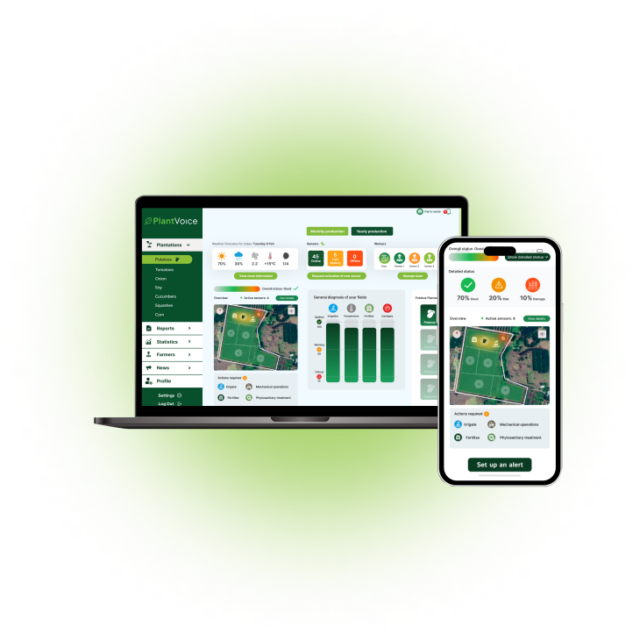
For those working in scientific research, PlantVoice is an essential tool for collecting reliable data without the need for complex laboratory equipment. With its intuitive interface, botanists can create detailed reports and compare data over time, facilitating studies on biodiversity, climate adaptation, and new cultivation techniques.
 Utilities for farmers and farms
The app is not only useful for academic botanists, but also for those working directly in the field. Farmers and farm managers can integrate PlantVoice into their daily practices to monitor crop health, prevent diseases and optimize production processes. The predictive analytics system helps prevent yield losses, reducing pesticide use and improving crop sustainability.