

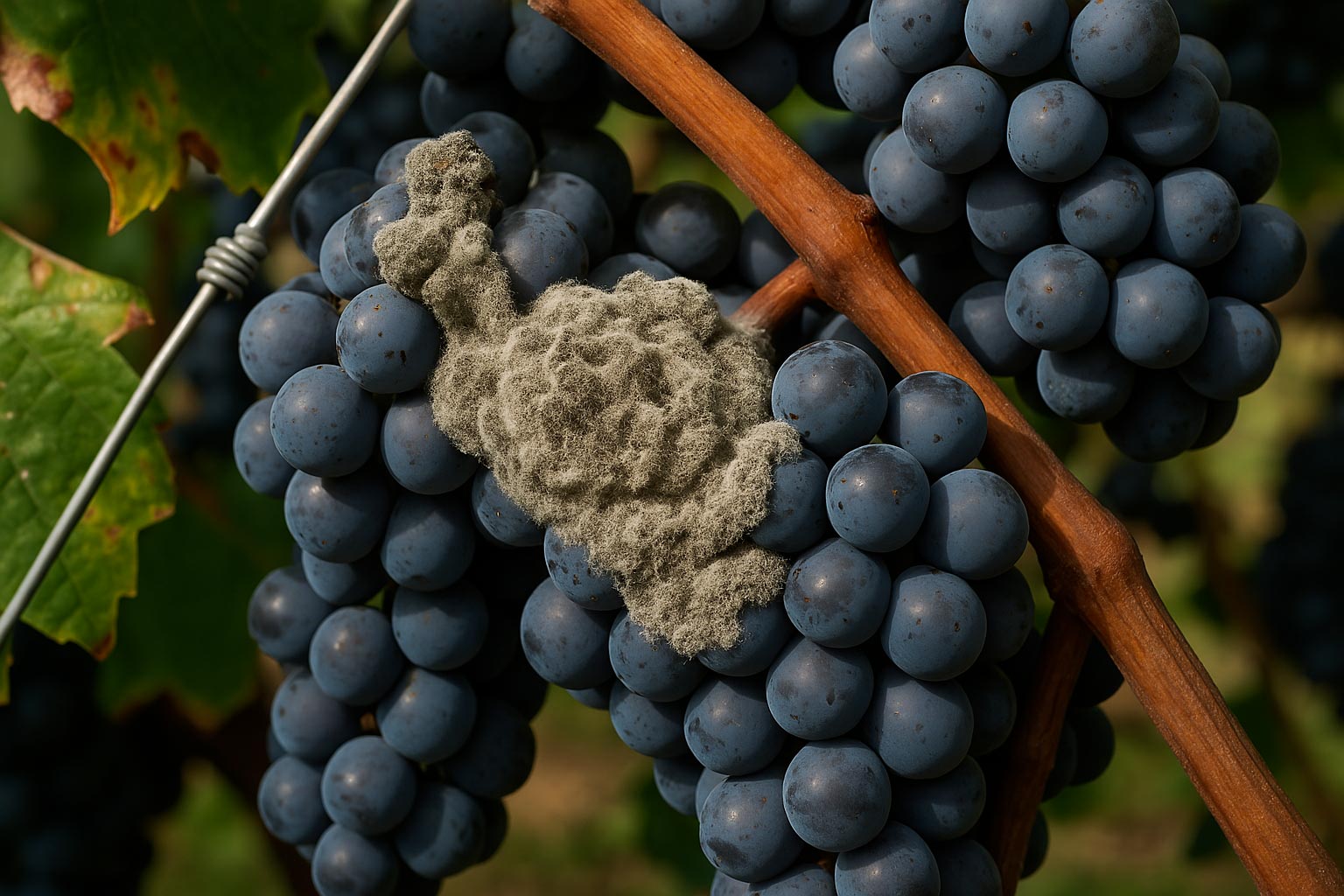
Gray mold, caused by the fungus Botrytis cinerea, is one of the most common fungal diseases in vineyards, although it also affects other fruit crops. This disease is manifested by the formation of a thin gray layer that covers fruit, leaves and stems, compromising the aesthetic appearance and quality of the final product. This article takes an in-depth look at the morphological characteristics of the pathogen, its infectious cycle and clinical manifestations, highlighting how digital monitoring can support early diagnosis.
Morphological and biological characteristics
Botrytis cinerea is an ascomycete fungus known for its ability to thrive in environments with high humidity and mild temperatures. Its spores, small in size and ovoid in shape, aggregate into conidia that form a characteristic gray-colored patina. The threadlike, branched mycelium expands rapidly within infected tissues, resulting in necrosis of plant cells. A unique feature of the fungus is its ability to remain in a latent state on plant debris, activating upon the occurrence of favorable environmental conditions.
Infectious Cycle and Mode of Spread
The cycle of Botrytis cinerea consists of several stages, closely related to environmental conditions:
- Spore dispersal: conidia are released and transported by rainfall, wind, and mechanical activities, settling on healthy surfaces.
- Germination and penetration: in the presence of high humidity, spores germinate and form germinative structures that penetrate tissues through abrasions or lesions.
- Mycelium expansion: once infiltrated, mycelium spreads rapidly, destroying cells and causing local necrosis.
- Production of new spores: as the infection progresses, the fungus generates additional spores, perpetuating the infection cycle and involving new areas of the orchard or vineyard.
The rapid spread of the pathogen makes continuous monitoring essential, especially in environments with constant humidity and frequent irrigation.

Clinical manifestations in Vineyards and other crops.
Symptoms of Gray Mold are easily recognizable and manifest progressively:
- Gray patina: the first evidence consists of a light gray covering on fruits, leaves and stems, a sign of the accumulation of spores and mycelium.
- Necrotic lesions: as the infection progresses, areas of necrosis develop affecting the skin and pulp, compromising the integrity of the fruit.
- Premature fruit drop: in severe cases, infection induces premature fruit drop, reducing fruit yield and commercial value.
- Leaf alterations: sometimes, the disease also extends to the leaves, causing discoloration and wilting, which weakens the plant overall.
These manifestations, which vary in intensity depending on the stage of infection, allow immediate clinical diagnosis when supplemented with periodic field observations.
Digital Monitoring and Early Diagnosis
Early diagnosis of infection is crucial to limit the expansion of Gray Mold. The use of high-precision sensors allows constant monitoring of physiological parameters, such as water flow and sap composition, indicators that can anticipate the appearance of visible signs. In this context, Plantvoice® technology fits in as an innovative tool. It takes advantage of miniaturized sensors strategically placed in vineyards to collect data in real time, enabling rapid identification of at-risk areas and targeted intervention.
Summary Table of Gray Mold
| Appearance | Description |
| Pathogen | Botrytis cinerea |
| Crops Affected | Vineyards, various fruits and other crops |
| Initial Symptoms. | Gray patina on fruits, leaves, and stems |
| Advanced Symptoms | Necrotic lesions, premature fruit drop, leaf changes |
| Favorable Conditions. | High humidity, mild temperatures, frequent watering |
| Mode of Diffusion. | Dispersion of spores by water, wind and mechanical activities |
| Digital Monitoring | High-precision sensors (Plantvoice®) that analyze water flow and sap composition |
Intervention Strategies
Effective management of gray mold is based on a combination of traditional agronomic measures and digital technologies. The main strategies include:
- Moisture control: irrigation regulation and good ventilation are essential to reduce the moisture level, a key element for fungus germination.
- Regular inspections: periodic observation of orchards allows early detection of the first gray spots, a sign of the onset of infection.
- Residue removal: timely removal of fallen leaves and fruit limits the presence of infected material, interrupting the infection cycle.
- Digital monitoring: the use of sensors to monitor physiological parameters makes it possible to identify abnormalities in real time, facilitating targeted interventions in at-risk areas.
These practices, integrated into a coordinated operational plan, make it possible to contain pathogen activity and protect the quality of the final product.
FAQ
- What is gray mold and what crops does it mainly affect?
Gray mold is a fungal disease caused by Botrytis cinerea, which mainly affects vineyards, but can also affect other fruits and crops. -
What are the early signs of gray mold infection?
Infection is initially manifested by the appearance of a gray patina on fruits, leaves, and stems, followed by necrotic lesions. -
Under what environmental conditions does gray mold develop?
Infection is favored in environments with high humidity, mild temperatures and frequent watering. -
What symptoms indicate that the infection is at an advanced stage?
In advanced cases, premature fruit drop and general tissue deterioration are observed, with obvious signs of necrosis. -
How can digital monitoring contribute to early diagnosis?
High-precision sensors detect changes in water flow and sap composition, identifying at-risk areas in real time for targeted interventions.


%20in%20Vineyards%20and%20fruit%20crops)
%20in%20Vineyards%20and%20fruit%20crops&description=&image=https://plantvoice.farm/wp-content/uploads/2025/03/muffa-grigia-vigneti-1024x683.jpg)