Damage starts when the skin passes 46-49 °C. Air temperature does not tell you that. The tree does.
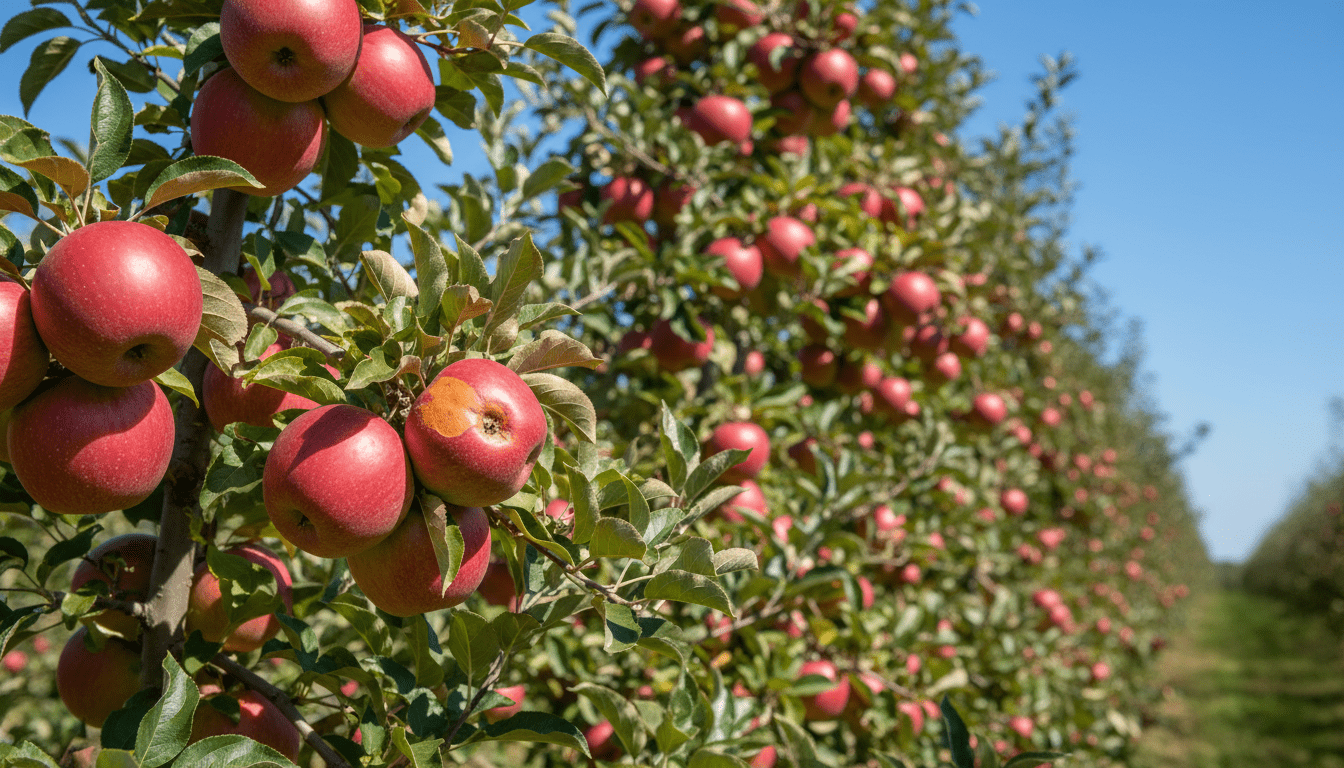
Sunburn is not decided by air temperature. It is decided on the skin of the fruit. Damage begins once the surface of an exposed apple reaches 46-49 °C, and above 52 °C the tissue goes necrotic (WSU Tree Fruit Production Guide). On a clear day with light wind, a fruit in full exposure runs 10-15 °C hotter than the air around it. Which means the risk is real long before the weather station reads 40 °C — and once the tree has closed its stomata, its ability to cool itself and its fruit by transpiring is already gone.
The numbers behind this are not marginal. Losses to sunburn across the world’s apple regions run from 10% to 50% of the crop, with 10-20% typical and 30-50% in bad years (Advances in Horticultural Science). Very little of it is fruit on the ground. Almost all of it is fruit that drops out of the fresh market and into processing at a fraction of the price.
Why is sunburn a bigger problem in modern orchards?
It looks like a paradox and it is really a design consequence. Sunburn has troubled apple growers for at least 75 years, but incidence has climbed with the spread of dwarfing rootstocks and high-density systems (Horticulturae, 2023).
Those systems exist to distribute light evenly across the fruiting wall, because even light is what delivers uniform red colour, and uniform red colour is what the packhouse pays for. The very same geometry puts a much larger share of the crop in direct sun. Colour and sunburn compete for the same resource, and no amount of management makes that trade-off disappear. It can only be steered.
The three conditions that produce the damage
Heat alone does not burn fruit. Three things have to line up on the same afternoon:
- Direct and ultraviolet radiation on the fruit surface.
- High air temperature, which limits how much heat can be shed.
- A tree that can no longer transpire, because stomata have shut.
The first two are weather, and any station will tell you about them. The third is physiology — and it is the one that decides whether the first two do damage.
A well-supplied tree transpires, and transpiration cools canopy and fruit. A tree under water deficit closes its stomata to protect itself, and from that moment the identical afternoon produces far higher skin temperatures. That is why two blocks in the same orchard, under the same heatwave, can come out with completely different levels of damage.
Do the countermeasures work? What the data says
| Strategy | Measured effect | Limitation |
|---|---|---|
| Overtree evaporative cooling | Lowers fruit surface temperature by up to 8.5 °C | No meaningful UV reduction; very high water use |
| Shade / photoselective netting | Substantial reduction in incidence | Can suppress red colour development at harvest |
| Kaolin-based particle films | Physical barrier on the skin | Need repeat application and even coverage |
| The three combined | Incidence reduced by up to 60% | Rising cost and management load |
Two figures deserve the attention of anyone signing off on capital spend.
First: evaporative cooling is genuinely effective on temperature, but it does not deal with UV. Fruit can burn with the system running, and when heat and radiation are both extreme, cooling on its own may simply not be enough.
Second, the water. Across roughly 179,000 acres of Washington apples, at the state’s average daily irrigation rate per acre, evaporative cooling accounted for about 36% of total irrigation water (WSU CSANR). That is the uncomfortable part: the most immediate defence against sunburn is also the single largest draw on the water budget, in the week of the year when water is tightest.
Getting ahead of the risk instead of chasing it
Most orchards manage sunburn reactively: watch the forecast, start the coolers when air temperature crosses a set point, count the damage at harvest. It half works, because the trigger is one of three factors.
The missing input is the state of the tree, and its advantage is that it moves first. Sap flow measured directly in the trunk responds within hours. When transpiration stops tracking atmospheric demand — the day climbs, the tree does not follow — stomata are closing. From that point the tree’s own defence against overheating is gone, and the same sunshine carries a different level of risk.
That changes two concrete decisions:
- When to run the coolers. Not at a temperature set point, but when high heat and stomatal closure coincide. On a system that consumes a large share of the orchard’s water, skipping the unnecessary starts is worth as much as catching the necessary ones.
- How to irrigate in the days before. A tree that meets the heatwave already in deficit closes down sooner and burns more. The useful window is the two or three days before, not during — the same logic as detecting water stress before symptoms appear.
Continuous plant health monitoring is for exactly this. Not to tell you it is hot — you know that — but to tell you whether the tree still has what it takes to handle it.
What to do this week
- Map the exposed blocks: rows whose fruiting wall faces the early-afternoon sun, young trees with incomplete canopies, shallow-soil patches.
- Check tree water status before the forecast heat arrives, not during it.
- If you run cooling, verify distribution uniformity and nozzle condition. A system that wets unevenly cools unevenly and wastes water anyway.
- On fruit already damaged there is no recovery. The decision worth making is about harvest sorting and where that fruit goes commercially — worth weighing against current wholesale apple prices.
- Write down what happened. Netting versus cooling is a planting-level decision, taken in winter, and it is only as good as this summer’s records.
Frequently asked questions
At what temperature do apples sunburn? Skin discolouration begins when the surface of an exposed fruit reaches 46-49 °C (115-120 °F), and necrosis can set in above 52 °C (126 °F). Those are skin temperatures, not air temperatures: on a clear day with light wind, an exposed apple sits 10-15 °C above ambient.
Does overtree cooling stop sunburn? Not on its own. Evaporative cooling lowers fruit surface temperature by up to 8.5 °C, bringing fruit close to air temperature, but it does not adequately reduce UV radiation. Sunburn still occurs under cooling, and when heat and radiation are both extreme, cooling alone may not be enough.
How much fruit is lost to sunburn? Documented losses across the world’s apple regions run from 10% to as high as 50%. Growers commonly estimate 10-20%, with 30-50% in the worst years. Most of it is downgrade rather than total loss: the fruit leaves the fresh channel for processing.
Why has sunburn got worse in modern orchards? Dwarfing rootstocks and high-density plantings are designed to spread light evenly through the canopy, which is exactly what produces uniform red colour. The same design exposes a far higher share of fruit to direct radiation. Colour and sunburn draw on the same resource.
How do you see sunburn risk coming? Three things have to coincide: high radiation, high air temperature, and a tree that has stopped transpiring. The third one is usually missing from the calculation and it is the one that decides. When sap flow decouples from atmospheric demand, stomata are closing and the tree’s own cooling has run out.
Sources
- Apple Sunburn — WSU Tree Fruit Production Guide
- Reviewing the Tradeoffs between Sunburn Mitigation and Red Color Development in Apple under a Changing Climate — Horticulturae 9(4)
- How suitable is apple orchard netting as a sunburn control measure? — WSU Center for Sustaining Agriculture and Natural Resources
- Heat and light induced physiological disorders in apples — Advances in Horticultural Science