If a vine has leaves rolled downward, yellow with a golden sheen (white grapes) or red (black grapes), and soft, hanging shoots, suspect flavescence dorée. There is no cure. The symptomatic vine is removed and the leafhopper that spreads the disease is controlled. In the countries where the disease is established, both are legal obligations, and the rules change from country to country, and often from region to region. Below: how to recognise it, the vector, the difference from bois noir, and what four countries actually require.
How to recognise flavescence dorée
Flavescence dorée is a grapevine yellows caused by a phytoplasma, a bacterium without a cell wall that lives in the phloem. Yellows look alike, and only a molecular test tells them apart. EPPO says as much: symptoms alone are unreliable. Your eyes give you a suspicion, not a diagnosis.
What to look for:
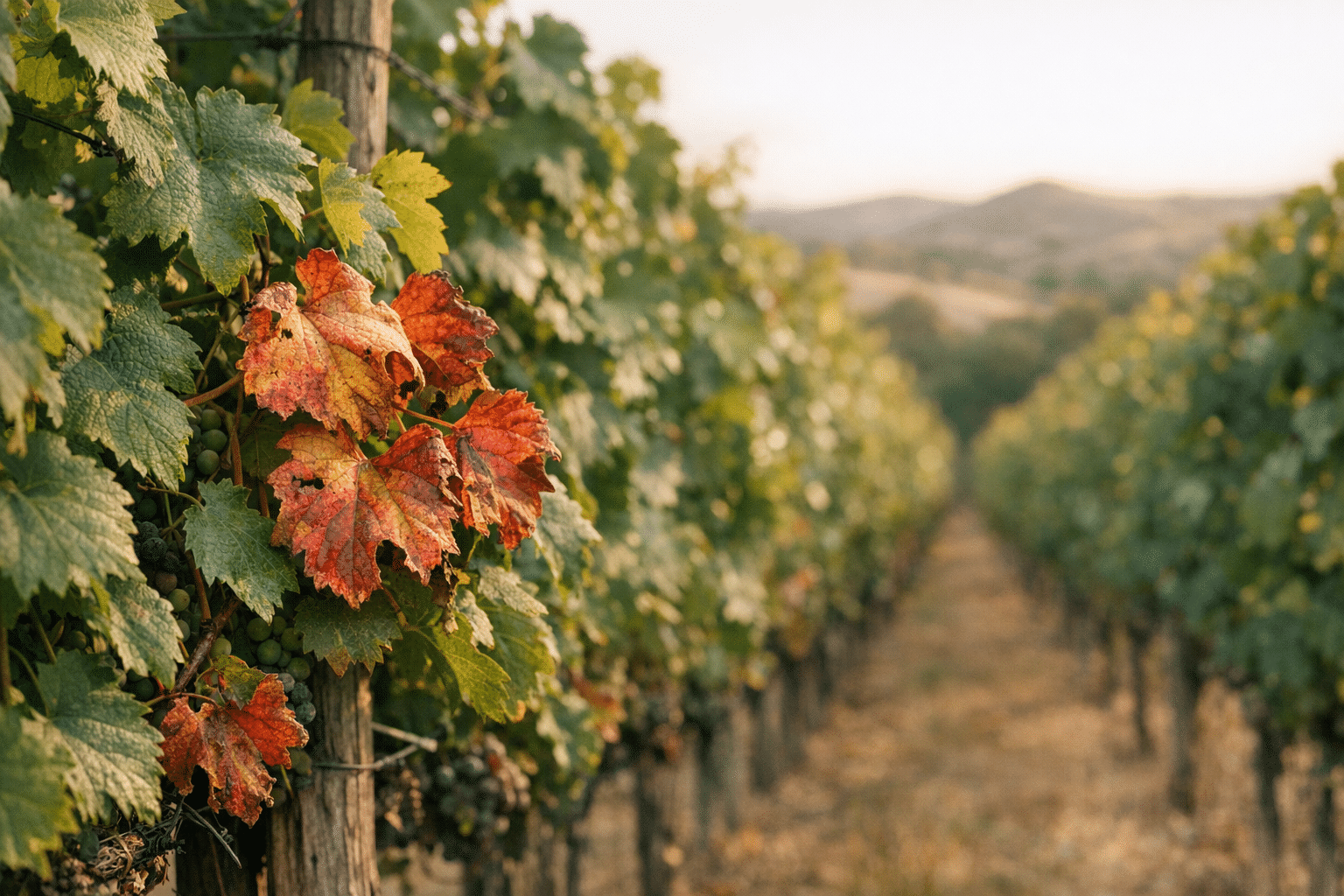
- Leaves: yellowing with a golden sheen on white varieties, bright reddening on black ones. The margins roll downward, and on sensitive varieties the leaf takes a triangular shape.
- Shoots: they fail to lignify, stay rubbery and bend toward the ground.
- Bunches: flowers abort, berries shrivel or dry out, and at harvest a bunch can be nearly bare.
- When: symptoms appear in summer heat and last until October. They often show up the year after infection.
Affected vines stand out against healthy ones, so a walk through the vineyard between August and October is enough to find them. The disease is on EPPO’s A2 list and is an EU quarantine pest (Regulation (EU) 2019/2072, Annex II B).
The vector: Scaphoideus titanus
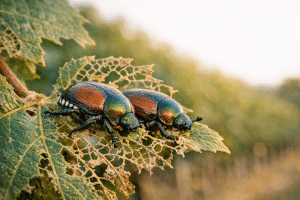
The disease moves from vine to vine through a leafhopper, Scaphoideus titanus. It lives only on grapevine and has one generation a year.
- Eggs: they overwinter under the bark of wood two years old or more.
- Nymphs: eggs hatch from mid-May and the young are found mostly under the leaves of suckers. They have two symmetrical black spots on the last abdominal segment and jump when disturbed.
- Adults: from late June to October. They are the riskiest stage because they fly, usually within 30 metres but sometimes 300 or more.
- Transmission: the insect picks up the phytoplasma from an infected vine and can pass it on after about 30 days. It stays infectious for life but does not pass it to its eggs.
Pruning shears do not transmit the phytoplasma, and neither do cuttings left on the ground. The eggs, however, sit in old wood. Grafting with infected material can also spread it, which is why nurseries are a risk point.
Flavescence dorée and bois noir
The two are confused because the symptoms are nearly identical. Flavescence dorée is caused by the flavescence dorée phytoplasma and carried by Scaphoideus titanus. Bois noir is caused by a different phytoplasma, Candidatus Phytoplasma solani, and carried by another leafhopper, Hyalesthes obsoletus. Only the lab can separate them.
For you, the difference is this: flavescence dorée is considered the most dangerous of the yellows because it is highly epidemic, and it is a quarantine pest. That is why the legal measures described below are about flavescence dorée.
What the rules say: four countries
| Country | Status (EPPO) | What the sources show |
|---|---|---|
| Italy | present, few occurrences | national emergency order of 22 June 2023; each region sets its own delimited area and rules. In Piedmont (2026) a symptomatic vine must be removed with no lab confirmation and grubbed up by 31 March; over 20% symptomatic vines means the whole plot goes. In the Veneto (2026) the same 31 March deadline and 20% threshold apply, with fines of EUR 1,000 to 6,000 |
| France | present, restricted distribution | national order of 27 April 2021, amended 9 May 2025; prefectural orders set zones and treatments. Alsace 2026: three insecticide treatments for nurseries and mother vines where the vector is present, and hot-water treatment of cuttings in delimited zones |
| Spain | present, few occurrences | Catalonia, Order ACC/231/2023: delimited zones with a buffer of at least 2.5 km, infected vines grubbed up, whole plot if over 20% infected, mandatory insecticide treatments in the zone |
| Germany | present, restricted distribution | vector first found in 2024 (Markgräflerland); pathogen first confirmed in November 2025 in Baden-Württemberg. Reportable; infected vines must be grubbed up and the vector controlled |
Rules are renewed every year, often in spring, so what you read here is the 2026 picture. Before a growing season, read the current text from your plant health service.
The United Kingdom is listed by EPPO as “absent, no pest record”. If you plan to bring in vines or cuttings from an affected area, remember that planting material can carry the disease. In Germany, the reference laboratory’s analysis suggests the phytoplasma arrived with infected plant material.
What to do in autumn
The treatment season is over. Now you work on the vines and the wood:
- Mark and remove symptomatic vines you saw between August and October: stump and roots, and take them out of the vineyard.
- Clear wild vines and abandoned rootstock on field edges, wasteland and riverbanks. In Germany, the Freiburg wine institute lists removing wild rootstock vines among the measures, because they act as a reservoir for both the insect and the disease.
- Remove or shred pruning wood older than two years, where the vector’s eggs are.
- When planting: use certified material. Hot-water treatment of propagation material (50 °C for 45 minutes, as recommended in Piedmont) adds a safeguard.
- If in doubt: report the suspicion to your plant health authority. In Germany it is a legal duty.
On insecticides, we name categories and not products. In Italy’s integrated vineyards the regional plans use a systemic insecticide first and a pyrethroid second. In organic vineyards they use natural pyrethrum, potassium salts of fatty acids and azadirachtin, mostly against the young stages. The label always has the last word. If you want the difference between registered azadirachtin and neem sold as a tonic, we explain it in neem oil: what it does and when you can use it.
Reading the plant
The Plantvoice sensor does not diagnose flavescence dorée. The lab does. It reads sap flow and salinity inside the trunk and tells you whether to irrigate now or wait. In a dry year, knowing how the vine is doing on water helps you rule out water stress when leaves change colour. We have covered how to detect water stress before symptoms appear and how the sap flow sensor works.
Frequently asked questions
How do you recognise flavescence dorée? Rolled leaves, yellow with a golden sheen (white grapes) or red (black grapes), shoots that do not lignify, shrivelled bunches. Symptoms appear in summer and last until October. A lab test is needed to be sure.
Can flavescence dorée be cured? No. Symptomatic vines are removed and the vector, Scaphoideus titanus, is controlled with the treatments the plant health service prescribes.
Is control mandatory? In countries where the disease is established, yes, with different rules in each: national and regional orders in Italy, a national order and prefectural orders in France, an autonomous-community order in Catalonia, reporting and grubbing up in Germany.
When should infected vines be grubbed up? During the season the symptomatic growth is removed or the vine cut back. In Piedmont and the Veneto the stump must be grubbed up in the dormant season, by 31 March.
What is the difference between flavescence dorée and bois noir? Nearly identical symptoms, different pathogen and vector: Scaphoideus titanus for flavescence dorée, Hyalesthes obsoletus for bois noir. Only the lab tells them apart.
Want a second pair of eyes on your vineyard before next season? Talk to our agronomists to set up monitoring, or ask for a trial of the Plantvoice sensor on your vines.