
The olive fruit fly ( Bactrocera oleae ) is the most economically significant pest for Italian olive growing . CREA-OFA data show that infestations exceeded 50-60% of the fruit in many farms in central and northern Italy in the 2025 crop year. The problem is not a lack of effective active ingredients, but the difficulty of maintaining continuous protective cover in an increasingly variable climate and of intervening at the right time .
In this article, we will see how to structure an effective monitoring plan , which intervention thresholds to apply for preventive and curative defense, and how the climatic conditions of the last two years have changed the strategies adopted in the main Italian olive-growing regions.
The Biological Cycle: Critical Windows Not to Be Missed
Bactrocera oleae completes 3 to 4-5 generations per year , with the number varying depending on climate. The cycle begins in April with the first emergence of overwintering adults, followed by a so-called “white” period when the fly is absent from the olive groves. The return occurs around mid-June , when the reproductive phase begins on susceptible drupes.
Oviposition begins with the hardening of the stone, generally between late June and mid-July . At 24°C , development from egg to new adult takes between 21 and 25 days. With cooler temperatures, the cycle extends to up to 120 days ; summer heat above 30-33°C, combined with low relative humidity, causes significant mortality of eggs and early-stage larvae.
The increasingly mild winters of recent years are reshaping the olive fruit fly’s calendar : they favor the survival of a greater number of overwintering forms and bring forward the moment when the fruit becomes susceptible to attack by about 15 days. Populations then grow significantly between September and October , the phase in which late or absent defense causes the most serious qualitative and quantitative losses.
Adult Monitoring: When to Start and Which Tools to Use
Monitoring is the foundation of any effective defense strategy . Without reliable data on the presence and dynamics of populations, any intervention becomes an inefficient and often belated attempt at timing.
Yellow chromotropic traps (with pheromone or food attractant) are the standard tool for detecting the presence of adults .
The protocol indicated by the Tuscany Region provides:
- March – early May
Weekly cadence.
Pheromone trap, with pheromones and food attractant, or yellow chromotropic.
Objective: to evaluate the size of the spring adult population (low, medium, high).
- Mid-June – late September
Weekly cadence.
Yellow chromotropic trap.
Objective: To define the optimal time for the first preventive intervention against adults in the first summer flight.
The indicative density is 1-3 traps per homogeneous plot of approximately 1 hectare . The data collected weekly allows us to track flight patterns and anticipate the critical stages of oviposition.
It’s important to note that traps detect the presence of adults, but they don’t automatically confirm that oviposition is occurring . Hot, dry conditions can lead to high catches without resulting in a significant infestation. Therefore, sampling the drupes is essential.
Drupe Sampling: The Threshold That Really Matters
Sampling is the only method for determining the actual level of active infestation , that is, the percentage of drupes with live eggs and larvae of the first and second instar stages. The intervention thresholds, according to integrated pest management guidelines, are:
| Type of defense | Intervention threshold | Notes |
| Preventive adulticide | 1-2% olives with eggs/larvae of the first stage, or 2-4 females/trap/week | To be activated before oviposition |
| Curative larvicidal (oil olives) | 7-14% active infestation | Early intervention: very narrow window of effectiveness |
| Curative (table olives) | Only visible sting | Zero tolerance for aesthetic defects |
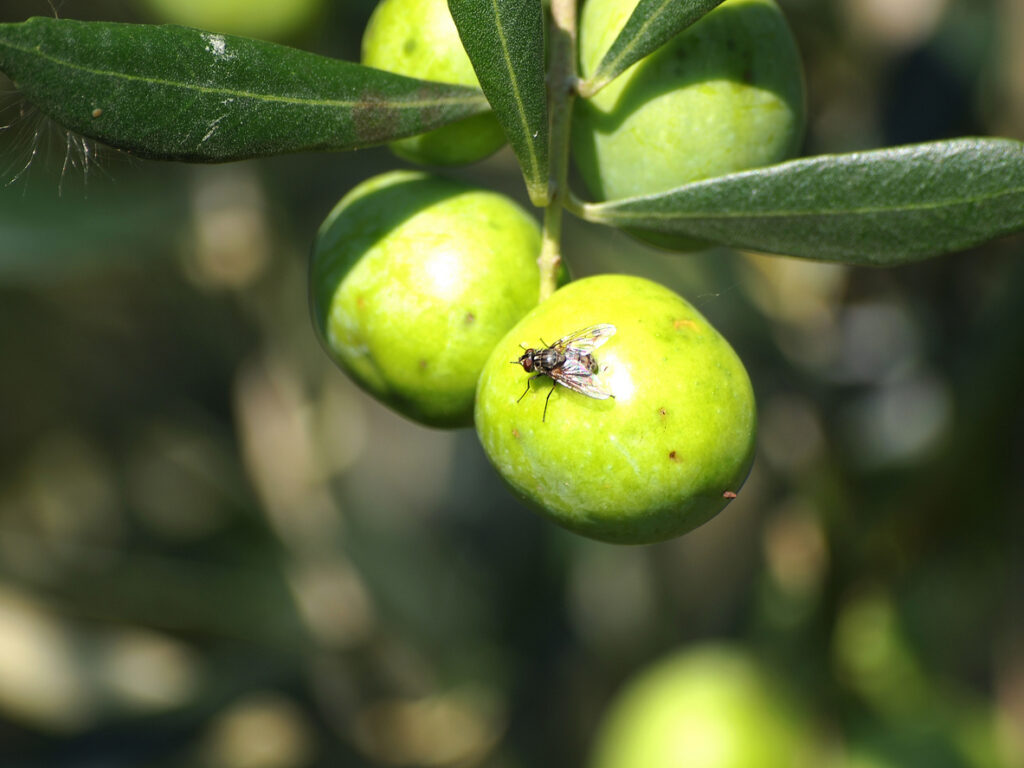
Sampling is performed by collecting at least 100 drupes per hectare from different plants and from different points of the canopy , to be analyzed with binoculars. It is important not to confuse an “active” infestation (live eggs and larvae) with a “harmful” infestation (third-stage larvae, pupae, exit holes).
The impact of climate on the dynamics of infestations
The years 2024 and 2025 clearly illustrate how climate variability affects control strategies . In 2024, high summer temperatures and prolonged drought naturally contained infestations across almost the entire country: in Liguria, Abruzzo, and Calabria, levels did not reach intervention thresholds for most of the season. In Tuscany, the average active infestation in the 2024 campaign remained around 1%.
In 2025, the scenario reversed : summer temperatures in the optimal development window (25-30°C) and sustained humidity favored a rapid succession of generations, with overlapping flight patterns. In Liguria, active infestation reached peaks above 50%. In Umbria, the average active infestation level for all sites was 16%, with peaks of 28% in the week of September 5, 2025. In Veneto, up to 4-5 partially overlapping generations were recorded.
This means that each campaign must be based on up-to-date field data, not fixed plans. Every year, the climate changes and affects the development and mortality of the fly . Monitoring is the only tool that transforms a generic plan into a decision tailored to the actual season.
Defense strategies: preventive, curative, or mixed?
The choice of strategy depends on the monitoring trend and the type of business management. Here are the main ones:
Preventive adulticide defense
It is activated before oviposition, typically in the last ten days of June when the stone hardens. It includes:
- Repellent rock powders (2.5-5% kaolin, zeolites, bentonites): anti-deposition effect, persists for 2-3 weeks in the absence of leaching rain. Kaolin has the added benefit of reducing thermal and water stress on vegetation.
- Beauveria bassiana : entomopathogenic bioinsecticide, repellent against oviposition, persists for no more than 7 days. It should be applied in the evening and nighttime.
- Copper products : in addition to their antifungal action, they interfere with the endosymbiosis between the larva and the bacterium Candidatus erwinia dacicola , making larval development more difficult.
- Attract & kill devices (Eco-Trap, Dakofaka, BioMagnet Oro): attract adults using pheromones and/or food attractants, with contact insecticidal action. Especially effective on crowded surfaces.
- Protein baits activated with spinosad : distribute on sections of the canopy (30-40 cm of wetting) in alternate rows. Up to 8 applications/year are permitted.
Larvicidal healing defense
It is activated when the active infestation threshold is exceeded . The active ingredients in integrated pest management are acetamiprid and flupyradifurone , with a maximum number of treatments defined by the regional integrated production regulations. Both show limited efficacy on second- and third-instar larvae : treatment must be carried out promptly, immediately after oviposition and before the larvae penetrate deeply into the pulp.
Early harvest
In the case of heavy autumn infestations , early harvesting often remains the only truly effective measure. The structural problem is that the products permitted in organic farming act primarily on adults or the very early larval stages . Once the larva has penetrated deep into the pulp, there is no active ingredient in organic farming capable of reaching and eliminating it . CREA-OFA highlights this gap as one of the unresolved critical issues in olive tree biological defense .
Integrated Monitoring: Beyond the Pitfalls
Structured monitoring isn’t an additional cost: it’s what transforms plant protection from a budget-driven expense into a decision tailored to the actual risk . Olive trees are susceptible to a variety of diseases , and a single problem rarely occurs in isolation. Those who monitor consistently have a comprehensive view that allows them to coordinate interventions , avoid overlaps, and address each problem within the time window in which treatments are truly effective.
FAQ – Questions about the olive fruit fly
How many traps are needed for effective olive fly monitoring?
The number depends on the size and homogeneity of the plot . The Tuscany Region guidelines recommend 1-3 traps per homogeneous plot of approximately 1 hectare , to be checked weekly. In organic olive growing and in areas at high risk of Dacian infestation (coastal strip, altitudes below 500 m), it is preferable to stick to 2-3 units per hectare . Counting the adults in the traps alone is not sufficient: it must always be supplemented with physical sampling of the drupes.
Is kaolin effective in all conditions?
Kaolin has a documented repellent and anti-deposition action , but its effectiveness is significantly reduced when the Dacian pressure is very high and in case of heavy rains (>20-30 mm), which require repeat treatment. In high-risk areas, the Tuscany and Calabria guidelines recommend combining it with other preventive measures, such as attract & kill devices or protein baits with spinosad, rather than using it as the sole strategy.
When is it better to opt for early harvesting instead of larvicidal treatment?
Early harvesting is the most effective measure on organic farms in areas with high autumn pressure . If infestations exceed the active threshold at the end of September and further larvicidal treatments are not available, bringing forward the harvest to between late September and early October helps safeguard the organoleptic quality of the oil, avoiding the “worm” defect caused by larvae in the drupes.
Plantvoice It provides a continuous view of the plant’s health, for decisions based on real data, not a calendar. Request a demo.