Although the olive tree is considered to be a hardy plant capable of enduring even rather harsh conditions, it is certainly not possible to rule out the possibility that it may be affected by olive tree (olive) diseases that can seriously jeopardize production and the very sustainability of the plant.
That is why, in this guide, we wanted to take stock of what are the characteristics of the main diseases from which the olive tree can suffer, then dwelling on the specifics of bacterial and fungal diseases, and finally introducing a technological innovation that will make the difference between a strong and healthy olive grove, and a poor and unproductive one.
Bacterial diseases of the olive or olive tree.
We begin this in-depth look at olive tree diseases with diseases of bacterial origin. Unfortunately, this range of olive tree diseases has been talked about a lot over the past few years, with Xylella making headlines for mowing down large olive groves in Apulia and beyond.
However, this is not the only bacteria that can seriously jeopardize the sustainability of one’s agricultural cultivation.
Rogna
Even more common than Xylella is in fact mange, one of the most frequent diseases of the olive tree. Caused by a bacterium that can penetrate the plant through wounds, it is often favored by the olive fly, especially if there are pronounced wet conditions.
Recognizing mange is not difficult: indeed, the first symptoms are manifested by typical green, soft, smooth swellings on young shoots, petioles, trunks, and roots. The signs of mange then tend to darken and, thus, flake off. On olives, however, mange manifests marks such as dark indentations or growths.
If action is not taken in time, olive mange can result in serious damage: branches can dry up and die, and latent buds can form in the apices. Over time, the olive plant slows its development and becomes unproductive.
To avert the most harmful consequences, it is a good idea to take action by carefully cleaning all tools used on the plant and to intervene with limited pruning that does not cause extensive wounds: it is from these, in fact, that the bacterium can spread. It is also good practice to remove diseased plant parts in a timely manner. As a preventive measure, copper can be used on pruning wounds and olive fly traps can be installed.
Xylella
So let’s go back to talking about Xylella, a bacterium that has unfortunately affected so many farmers in Puglia, and beyond.The problem initially manifests itself with a drying up of the leaf apices, and then moves on to attack the main branches of the plant, leading to its death.
The Gram-negative bacterium lives and reproduces inside the xylem vessels, which allow water and mineral salts to circulate within the olive plant.
Unfortunately, countering Xylella is very difficult: in fact, the bacterium has several host plants such as almond and oleander, and many are wild. As for the vector, it has long been identified in Philaenus spumarius, or medium spittlebug, an insect that stings the plant, promoting the spread of the infection.

Curiosity: Olive or Olive Tree? Discover the Difference between the Two Terms
When talking about this iconic Mediterranean plant, a linguistic doubt often arises: we say olive tree o olive tree? Both terms are correct, but they have different nuances that are worth exploring.
Origin and Use of Terms
The word “olive tree” is derived from the Latin olivum and is mainly used in technical, botanical and agricultural fields. It is the most widely used term in scientific texts and specialized publications.
The variant “olive tree”, on the other hand, is a more recent adaptation and derives from the popular Latin form olivum transformed over time by the evolution of the Italian language. This term is more common in everyday and literary language, often evoking a more poetic and symbolic image of the plant.
Fungal diseases of the olive tree
Alongside bacterial diseases of the olive tree, consideration should also be given to the rich range of fungal diseases.
Indeed, diseases derived from fungi are widespread and, unfortunately, are often capable of causing irreparable damage to plants. Again, it may be useful to summarize in brevity what the characteristics of each of the main hypotheses are, in alphabetical order.
Anthracnose
L’anthracnose is a fungal disease determined by the role of the agent Gloeosporium olivae, which infects the plant during the fall season. The most obvious signs of the disease are the presence of dark sunken indentations, with a white halo, at the olive lenticels. The indentations can also affect the entire drupe.
During the following winter season, the disease results in the appearance of spots on the leaves, which are round, white, and sunken. On the branches, on the other hand, ochre, depressed spots appear, with a symptom manifesting the advanced development of the disease.
As for remedies, it is best to remove attacked branches and affected fruit, then carefully clean all tools. Treatments made with copper are also generally considered effective.
Brusque parasitic
Also falling into the category of fungal diseases is the parasitic brusca, determined by the pathogen Stictsi panizzei. The disease has as its first element of recognition the presence of brick-red spots on the leaves of olive trees, which later take on a brown color, with slight depression on the lower page, especially during autumn, if hot and humid.
If the disease is not intercepted and addressed promptly, the next developmental stage is characterized by leaf drop and loss of productivity of the olive tree.
As for the main remedies, copper treatments are always indicated.
Cercosporiosis
The third fungal disease we are concerned with is cercosporiosis, caused by the fungus Cercospora cladosporiodes.
The first symptoms of the disease are found in the lower part of the leaves of the olive plant, where dark, velvety-textured spots appear. In the upper part of the leaves, on the other hand, dark, chlorotic areas will appear. In the second stage of the disease, leaf drop follows.
To defend against cercospora, especially in humid environments, where the disease may occur more frequently, it is best to use copper-based treatments, in the fall – winter period.
Smoke
Fumigation is one of the most well-known diseases of olive trees and faced by farmers. Determined by fungal pathogens such as those belonging to the genera Capnodium, Pleosphaeria, Ceratocarpia, Peyronellea, Aureobasidium, Cladosporium, and Alternaria, it is manifested by covering leaves, shoots, branches, and drupes of olive trees with a dark-colored coating of sooty texture, hence the common name of the disease.
In reality, the substance is nothing more than the mycelium and fruiting bodies of fungi that will eventually envelop the parts of the plant affected by the disease, polyphagous organisms that feed on the honeydew produced by the plant following aphid attacks. The damage caused by fumaggine to olive plants is indirect: there is no real aggression, but the formation of the scab prevents gas exchange and photosynthesis activity, leading to drops in production and, in the most severe cases, the death of the plant.
Considering that the disease is favored by insects such as aphids and mealybugs, treatment can only involve combating these pests.
Olive leprosy
Other fungal pathological conditions include olive leprosy, a disease recognizable when a round, sunken, blackish-brown notch appears on the fruit. Over time, the olive that is affected by leprosy dries out. The oil contained within becomes sour and cloudy. The leaves are generally not affected by this condition, but when leprosy also affects the foliage, it does so by causing yellow spots to appear, preceding the fall of the leaves themselves.
The disease is favored by the occurrence of certain conditions such as high humidity. Therefore, one can try to prevent leprosy by carrying out regular pruning aimed at eliminating moisture stagnation. In addition, in case one wants to increase the level of effectiveness of counteracting actions, one can consider adopting irrigation methods that avoid canopy wetting. Also in this scenario, copper-based treatments in the fall can be functional in coping with the disease.
Olive mycosis
Olive mycosis is caused by the fungus Sphaeropsis dalmatica, a pathogen that usually occurs in plants that have already suffered attacks by olive flies. Olive mycosis is manifested by the presence of necrotic spots on the fruit that are sunken, round, with a lighter raised edge, and other black spots.
To defend against the disease of olive mycosis, counteraction aims to attack the insect that causes it.
Peacock eye
Peacock’s eye is another fungal disease that can affect the olive plant. Produced by the fungus Spiloceae oleaginea, the disease has as its most obvious symptom the presence of circular spots on the leaves, more or less extensive, similar to small eyes, especially when the spots, in the second stage, become gray in color and are surrounded by a yellow halo.
Gradually, the leaf tends to yellow and fall off, thus taking away some useful surface area for photosynthesis in the plant and damaging the health of the entire olive tree.
Again, the best defense against this fungal disease is prevention: copper treatments are always advisable.
Septoriosis
Derived from the fungus Septoria, septoria is a disease that causes light or brown spots to appear in already weakened olive plants. The same rules already seen for other fungal diseases apply to prevent and treat this disease.
Diseases of the olive tree trunk – olive tree
In the past few lines we have talked extensively about olive tree diseases, focusing especially on those that cause prevalent foliage problems.
We can also deal here with diseases of the trunk of the olive tree, that is, pathological conditions that also or especially affect the trunk of the plant, putting its survival at risk.
Although we have already mentioned some of these in the past few lines, it is useful to summarize them in a table for practical reference.
| Disease | Symptoms | Treatment |
| Olive tree weevil | It is one of the best-known bacterial diseases of the olive tree trunk. It is manifested by the formation of tubercles of various sizes on the trunk, branches, and sometimes on leaves and fruit. The bacterium responsible for the disease can enter the plant due to pruning wounds or weather damage, impairing sap circulation and creating new entry points for other pathogens. | Prevention of the disease relies on choosing less susceptible varieties of olive trees, disinfection of pruning tools, and copper-based treatments. |
| Wood decay | Provoked by various lignivorous fungi, the agents have the ability to degrade lignin and cellulose, hollowing out the trunk. | Removing infected wood by protecting pruning wounds with fungicide mastics and eliminating excess moisture conditions around the trunk. |
| Verticilliosis | Caused by the fungus Verticillium dahliae, it is a very dangerous disease. The infection starts at the roots, producing toxins and impeding sap flow. Branches and foliage wilt. Leaves turn yellow and fall off. | There are no curative treatments once the plant is infected. Thus, management is based on prevention, using pathogen-free plants and tolerant varieties, as well as avoiding planting in contaminated soil and keeping plants in good vegetative condition to increase their natural resistance. |
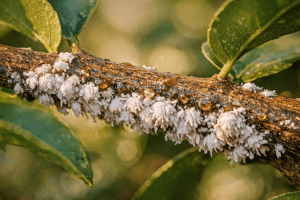
| Cochineal half a peppercorn | Saissetia oleae, or half-peppercorn mealybug, is a phytophagous insect of the order Rhynchus that can infest not only the leaves of the olive tree but also the trunk and branches. The adult females of the disease-causing insects, which are wingless and attached to the plant, lay up to 2,000 eggs that hatch and spread on the plant.
The developing insects feed by sucking sap from plant tissues, thus robbing the plant of energy and causing yellowing, vegetative decay and reduced production. Indirect damage, often more severe, is related to the abundant production of honeydew, a sugary substance excreted by the insect that coats the affected parts, reducing photosynthesis. |
To cope with this condition, it is advisable to adopt agronomic methods such as pruning to aerate the canopy, in addition to biological methods (favoring natural predators such as the beetle Chilocorus bipustulatus and the parasitoid Metaphycus helvolus) and chemical methods, with application of mineral oils or specific insecticides.
|
| Fleotribo | Phleotribo or “olive weevil” (Phloeotribus scarabaeoides) is a particularly dangerous scolytrid beetle, as it can dig tunnels under the bark large enough to impair the vascular function of the plant.
The main damage is caused by both the aforementioned reproductive tunnels dug by the adults and the trophic tunnels that the adults of the new generation dig at the insertion of the year’s shoots or at the base of the inflorescences. The result is gradual desiccation of twigs, shoots and inflorescences, resulting in reduced production. In severe infestations, entire branches may dry out, and young plants may even die. |
To manage the problem, a localized insecticide treatment is usually applied to trunks and main branches during the period of increased adult activity. |
| Olive tree bark beetle | Finally, the olive bark beetle, known as Hylesinus oleiperda, another beetle similar to the phleotribe but with distinctive biological and ecological characteristics. Slightly larger in size, it is a serious threat to the health of the olive tree trunk and branches, especially in neglected or stressed olive groves.
The bark beetle also prefers older and larger diameter wood, such as the trunk and main branches, where it digs deeper tunnels that can reach the wood. Its biological cycle generally involves only one annual generation. The main damage is caused by disruption of lymphatic vessels and subsequent impairment of sap flow. |
To cope with the disease we usually focus on preventive measures by keeping plants in good vegetative condition, carrying out proper pruning by avoiding excessive cuts, protecting pruning wounds with specific mastics, and promptly removing heavily infested branches. In case of significant attacks, localized insecticides are applied to the trunk and main branches during the adult flickering period. |
The Plantvoice ecosystem for plant wellness
Given the dangerous nature of olive tree diseases, especially when the diseases are not prevented and addressed in a timely manner, it becomes essential to equip one’s cultivation with a plant health monitoring system that can ensure real-time sap analysis.
The Plantvoice ecosystem is, in this respect, the most prominent technological development in the field: unlike traditional methods that observe the external environment, this internationally patented system operates directly from inside the plant.
Indeed, the heart of Plantvoice is a minimally invasive phytocompatible device that, inserted into the stem, functions as a “plant electrocardiogram,” monitoring salinity and lymph flow. The data collected is processed in the cloud by artificial intelligence-based software.
The “sensor as-a-service” approach enables farmers to:
- Detect water stress early, optimizing irrigation
- Identify the occurrence of fungal and bacterial pathogens before they spread
- Check the effectiveness of agronomic treatments in real time
Thus, thanks to Plantvoice, farmers can maximize yields and quality of production while making optimal use of valuable resources such as water, fertilizer, and pesticides for more sustainable and efficient agriculture.
To learn more, you can contact us at these addresses.