

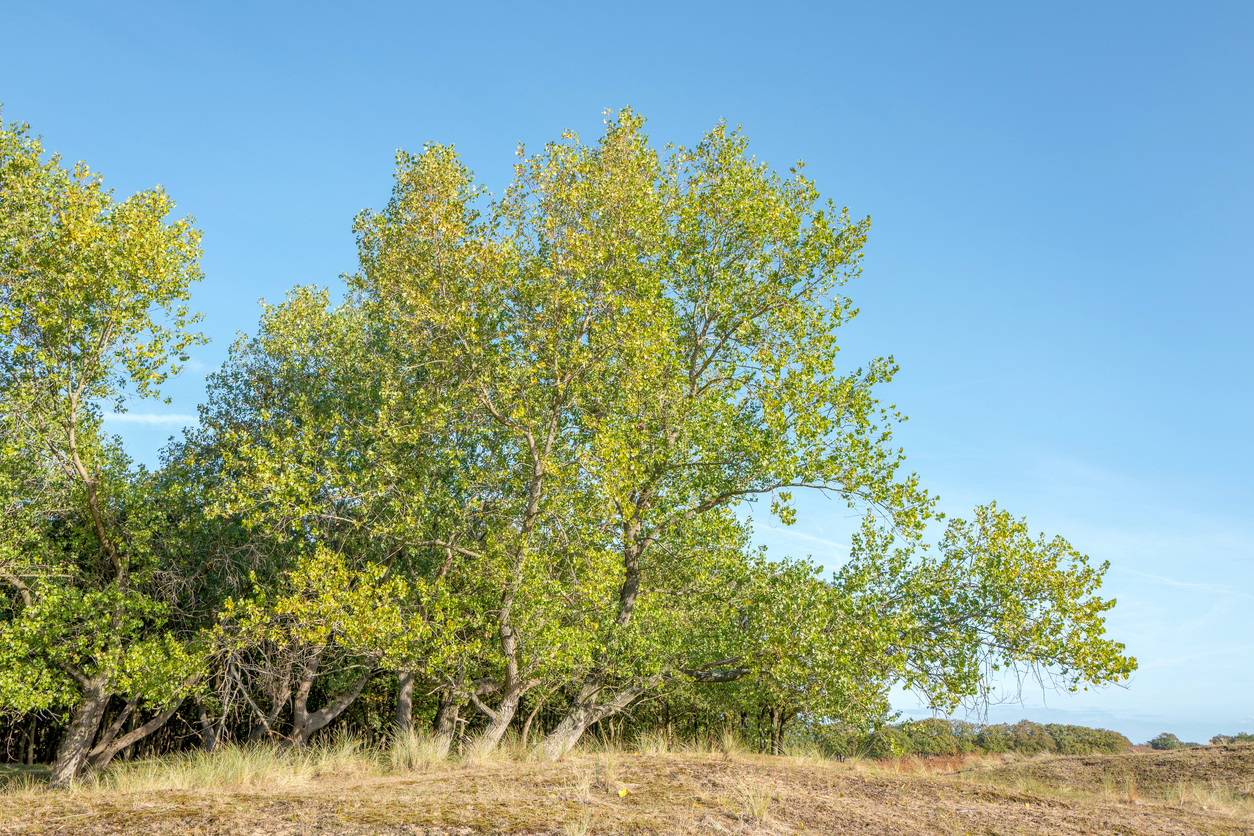
The white poplar ( Populus alba L.) is one of the oldest and most recognizable tree species in the European landscape . Already known to the ancient Romans, who called it arbor populi , “tree of the people,” for the characteristic rustling of its leaves in the wind, Populus alba has remained a fixture in both the natural ecosystem and agricultural activities over the centuries.
In this article we will explore why its cultivation is interesting today, both from an agricultural and economic point of view.
The white poplar: history and identity
As mentioned, the white poplar is a long-lived and robust plant, easily recognizable thanks to some distinctive features:
- Stem erect, most of the time wavy or branched.
- Broad and rounded crown .
- The bark changes appearance with age: in young trees, it is smooth, ranging in color from white to light gray with green hues; over time, it progressively darkens until it becomes almost black.
- Broad leaves , with the underside covered in dense white hairs — a distinctive feature from which the species name derives — which maximizes the ability to capture sunlight.
The white poplar is a fast-growing plant and, from a habitat point of view, we can find it in woods near rivers and in lands subject to periodic flooding or exposed to prolonged periods of drought . It is also a crop that adapts remarkably to temperature changes . In fact, it can tolerate temperatures between -25°C (-13°F) and 35°C (95°F). This characteristic means that it is present in a wide variety of environments . However, it sometimes requires specific defense systems in extreme climates, which, if not implemented, could cause very serious consequences. For example, to resist the cold, mulch is used, which should be applied around the base; however, to combat excessive heat, it is advisable to water appropriately and create shaded areas .
What are the visible signs of these conditions? Extreme cold causes the white poplar to be damaged by frost , which turns the leaves brown , while heat causes the leaves to burn or wilt. Furthermore, it tends to develop numerous root suckers , which facilitate the formation of compact and extensive vegetative groups . In contrast, the hybrid gray poplar is distinguished by alternate, simple-shaped leaves, covered with a dense down that accentuates their movement in the wind.
Ideal growing environments and cultivation methods
White poplar grows primarily in temperate climates and requires at least six hours of sunlight a day to grow healthily and vigorously. When it comes to cultivation , there are some key practical aspects to keep in mind:
- Adequate space and a sunny location: Populus alba requires ample space and direct exposure to sunlight; a shaded or excessively narrow location significantly limits its growth.
- Distance from buildings: it is advisable to plant it no closer than 10 meters from buildings, since its root system is robust and spreads widely in the soil.
- Water management: Although they require a good supply of water, especially in the early years of life, it is essential to avoid water stagnation, which can cause serious damage to the root system.
Growth cycle of the white poplar
Under favorable conditions , Populus alba can significantly increase its height in the first few years of its life. Reproduction occurs primarily vegetatively , through cuttings taken from 1-2 year-old shoots , since white poplar seeds have an extremely short lifespan and rarely give rise to new plants under controlled conditions. Planting typically takes place during the winter season .
Flowering occurs between February and April : during this period, the catkins—the characteristic pendulous inflorescences—appear first, followed by the leaves, as is typical of deciduous species. The fruits ripen between May and June .
Once mature , the tree reaches 25-30 meters in height . The production cycle varies based on the use of the wood and the variety grown: for the pure white poplar it is around 15-20 years , while for the most common commercial hybrids it can go down to 10 years . In natural contexts, the white poplar can live much longer: in fact, it is considered the longest-lived species and the least susceptible to disease of the entire Populus genus.
Uses of white poplar
White poplar has a wide range of uses, thanks to its combination of rapid growth and the wood’s technical characteristics that are particularly suited to industrial processing. The sapwood—the outer part of the trunk—of this tree’s wood is white , clearly distinguishable from the darker internal heartwood. It is a soft, homogeneous wood , as well as lightweight , with a density of approximately 410 kg/m³. These properties make it easy to work and suitable for numerous applications: it is used in the production of cellulose, plywood, packaging, fruit crates, and matches .
White poplar is also used as an energy source , both as firewood and, more generally, as a biomass fuel —a growing use thanks to the demand for renewable energy. Other significant uses include veneer and plywood, paper pulp, and the production of biomass from processing residues.
How much does it cost to grow white poplar?
The profitability of growing white poplars depends on several factors and is difficult to define in absolute terms. The main costs are concentrated in the initial phase : purchasing the cuttings, preparing the soil, and planting, in addition to the initial care, such as irrigation, weed control, and pruning. Once established, the plantation requires limited intervention, significantly reducing maintenance costs.
Profits come mainly from the sale of wood , which is used for various industrial purposes, as discussed in the previous section. These products do not have a high unit value , but the quantities produced and relatively short cycle times can make the crop competitive . It is worth noting that, under current market conditions, poplar cultivation can achieve profits comparable or higher than those of alternative agricultural crops, even in the absence of specific subsidies. However, the strong variability of wood prices makes profitability sensitive to market dynamics: in the most unfavorable situations, with high costs and low prices, margins are significantly reduced.
One factor to keep in mind is the long production cycle of pure Populus alba , which delays economic returns . Finally, it’s important to note that poplar plantations are not eligible for direct payments under the CAP , although in some specific contexts they may be eligible for public incentives linked to reforestation projects, renewable biomass production, or landscape protection.
Advantages and limitations of growing white poplar
Before starting a white poplar cultivation, it is useful to have a clear picture of its strengths and weaknesses.
Among the main advantages are rapid growth, low long-term management costs, the versatility of the wood’s uses, and its environmental benefits—in terms of soil stabilization, erosion reduction, and CO₂ absorption. It is also the most disease-resistant poplar species, which reduces phytosanitary risks compared to commercial hybrids.
Regarding limitations , wood is not suitable for high-quality structural applications, which limits its market value. As mentioned, the long production cycle delays economic returns, and the tendency to produce root suckers can make space management more complex over time.
In summary, white poplar is a crop suitable for those seeking a long-term investment , with low costs and a positive environmental profile , but which requires a careful evaluation of the context before being started.
FAQ – Frequently Asked Questions about White Poplar
- Is white poplar also suitable for small plots or family crops?
Yes, it can be grown even on small surfaces , as long as there is sufficient space for root and crown development. However, to achieve a significant economic return, it is generally preferable to plant it on medium to large surfaces. On small plots, white poplar is more suitable for landscaping, environmental purposes, or for self-consumption, such as the production of biomass for home heating.
- What sustainable management practices can improve crop yields?
Adopting techniques such as integrated weed management, efficient irrigation (e.g., drip irrigation), and choosing certified clones can increase productivity and reduce long-term costs. Furthermore, incorporating the crop into agroforestry systems, combining poplar with other slower-growing tree species such as walnut or English oak, can improve soil fertility and diversify income sources over time.
- Is the white poplar wood market stable over time?
The market is generally tied to demand from the pulp , packaging, and biomass energy sectors. However, it is not without risks : in recent decades, real poplar wood prices have undergone significant declines, making profitability sensitive to market dynamics. For this reason, before starting a plantation, it is essential to evaluate the presence of local supply chains or enter into supply contracts with stable buyers, thus reducing exposure to price volatility.
Start your investment today: visit Plantvoice .


