

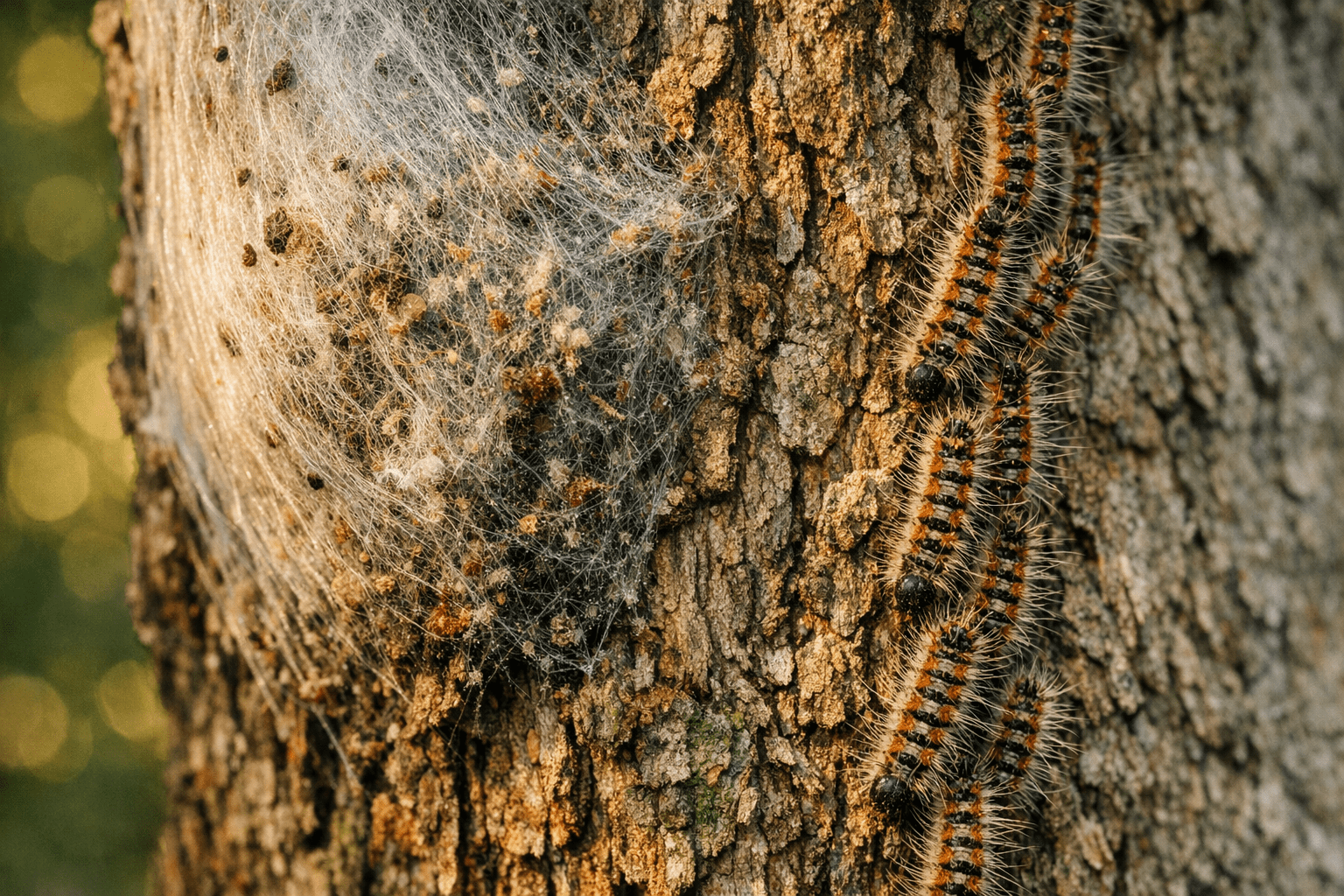
There is one good window against processionary caterpillars: a Bacillus thuringiensis treatment on the first and second larval stages, before the irritating hairs even form. After that you are down to professional nest removal and keeping people away from the tree. Two things that rarely get said together: in England, oak processionary moth is a notifiable pest and you are required to report a sighting, and the real danger is not the defoliation — it is the hairs.
Because that is where the harm is. A stripped oak flushes again. A child on the playground under it, a dog that pushes its nose into a procession, a grounds worker without a suit: those are the cases that cause trouble.
Two species, one problem
Oak processionary moth, Thaumetopoea processionea, is the one that matters in the UK and across much of northern Europe. It was accidentally introduced to England in 2005 and is now established across most of Greater London and parts of the surrounding counties.
Pine processionary, Thaumetopoea pityocampa, is the southern European species, on pines and cedars, and it is moving north. If you keep a place in France, Italy or Spain, this is the one you will meet — and the advice on skin, eyes and dogs is identical.
Neither bites and neither stings. The damage comes from the hairs the caterpillars develop from the third larval stage onwards. They are microscopic, they detach at the slightest disturbance, they travel on the wind, and they stay active for years — including in an old, long-abandoned nest. That last point is where most guidance stops one step too early.
In people they cause itchy rashes, conjunctivitis and, in sensitive individuals, breathing problems. In dogs the picture is worse, because a dog explores with its nose and mouth: contact with tongue and mucous membranes, rapid swelling, and in severe cases tissue necrosis.
If your dog has had contact, this is the only part of this article worth memorising:
- Never rub. Rubbing breaks more hairs and makes everything worse.
- Rinse thoroughly with lukewarm water, ideally with a little bicarbonate of soda, wearing gloves.
- Get to a vet immediately, even if it looks minor. Hours count.
In England, reporting is not optional
Oak processionary moth is regulated as a quarantine pest known to be present in Great Britain. In plain terms: it is under official control, and if you find a nest or caterpillars you must report it to the Forestry Commission — through TreeAlert, or by email to opm@forestrycommission.gov.uk, or by phone. Send a photo and a location; that is what makes a report usable.
What happens next depends on where you are. The country is split into three operational areas: an established area, a buffer zone, and a pest-free area.
- In the buffer zone or the pest-free area, a find usually brings a Statutory Plant Health Notice telling the landowner what must be done. In most cases the treatment of infested oaks is carried out on the landowner’s behalf by the Forestry Commission, under a Defra-funded survey and control programme.
- In the established area, control is about managing risk where people are — schools, parks, playgrounds, streets — rather than eradication. That responsibility sits with whoever manages the site.
Elsewhere in Europe the legal shape differs and it is worth knowing before you assume: in France both processionary species have been classed as harmful to human health since 2022, with the actual obligations set locally; in Italy the pine species is under compulsory control; in Germany there is no nationwide duty, but the owner’s general duty of care produces much the same result.
The calendar, month by month
| Period | What the insect does | What you do |
|---|---|---|
| April to early May | Hatching, first and second larval stages, no hairs yet | The only genuinely good window: a B.t.k. treatment, once presence is confirmed |
| May to July | Hairs from the third stage on, nests on the trunk | Peak health risk. Cordon off the tree; have nests removed by a specialist |
| July to August | Moths on the wing, eggs laid on thin twigs | Highest load of loose hairs in the surroundings. Pheromone traps for monitoring |
| September to March | Empty nests, egg plaques in the crown | Have nests removed — the hairs are still active. Plan the spring treatment |
The point that decides the outcome: spring beats summer. Miss the hatch and you have lost the cheapest lever of the year, and from then on you are only working on consequences.
The methods, and when to choose which
Bacillus thuringiensis subsp. kurstaki. The best ratio of effect to risk, but only on the first and second larval stages, and only once a population has actually been confirmed. It is relatively selective for free-feeding moth caterpillars, so other insect groups take less collateral damage. On large caterpillars it does almost nothing.
Nest removal by vacuum. Possible only from the third stage onwards, labour-intensive, and done in full protective equipment by a specialist contractor. It is the surest way of getting nests and hairs out of a site — but it is never complete, and it barely dents next year’s population.
Thermal methods, hot water or hot foam, kill the caterpillars and can denature the proteins in the hairs. In built-up areas this is a serious alternative.
Pheromone traps. They do not catch enough moths to reduce a population. They tell you whether the species is present and how much of it there is, and they are read as a run of several years, not as a single number.
What not to do: do not burn nests, do not blast them with a hose, do not go near them with a leaf blower. All three scatter the hairs and enlarge exactly the risk you were trying to remove.
Who to call
- Anywhere in England, on any oak: report the sighting to the Forestry Commission through TreeAlert first. That step comes before hiring anyone.
- Street trees, parks, schools and playgrounds: the local authority’s tree or grounds team.
- Trees on private land: a contractor equipped and trained for the work, who will give you a written record of what was done.
- An animal that has had contact: the vet, immediately.
Where reading the tree comes in
A sensor in the trunk does not count caterpillars. Your eyes and the traps do that.
What sap flow data tells you is something else. An oak stripped in May will flush a second time, and that second flush costs reserves. Add a dry summer and a survivable injury becomes a permanent one. Keeping a tree out of water stress in the year after a heavy attack is what decides whether it recovers or falls behind. The tree says so first: its water use changes weeks before the crown shows anything. On how that is read, we have written about detecting stress before the symptoms appear and about how the sap flow sensor works.
Frequently asked questions
Are processionary caterpillars dangerous to humans? Yes, because of the hairs the caterpillars develop from the third larval stage. They cause itchy rashes, conjunctivitis and, in sensitive people, breathing problems. You do not need to touch them: the hairs travel on the wind and stay active for years, including in an empty nest.
What do I do if my dog touches a processionary caterpillar? Do not rub. Rinse at length with lukewarm water, ideally with a little bicarbonate of soda and wearing gloves, and take the animal to a vet immediately. Contact with the tongue and mucous membranes can lead to necrosis, and hours count.
Do I have to report oak processionary moth? Yes. In England it is a notifiable quarantine pest and sightings must be reported to the Forestry Commission via TreeAlert, with a photo and a location. In the buffer and pest-free areas a report usually leads to a Statutory Plant Health Notice, with treatment often carried out on the landowner’s behalf.
When is the right time to treat? On the first and second larval stages, usually April to early May, before the hairs form, and only once presence has been confirmed. Later in the season treatment achieves very little and nest removal is what remains.
Can you burn processionary caterpillar nests? No. Burning, hosing and leaf blowers all scatter the irritating hairs and raise the health risk. Nests are vacuumed off or treated thermally, normally by a specialist contractor in full protective equipment.
Want to go into the season with trees that can take it? Talk to our agronomists about setting up monitoring on your site, or ask for a Plantvoice sensor trial on your own trees.
HERO_PROMPT: Ultra-realistic editorial photograph of a dense silk nest of oak processionary caterpillars on the trunk of an old oak tree, with a tight procession of hairy caterpillars moving along the bark beside it, dappled late-spring woodland light. Extreme detail on the caterpillar hairs and the silk webbing against the oak bark: visible texture, natural imperfections, true-to-life colour. Shot on a full-frame DSLR, 100mm macro lens, shallow depth of field with clean bokeh, soft natural daylight with golden-hour warmth, high dynamic range, realistic shadows and highlights, subtle analogue film grain (Kodak Portra 400), cinematic colour grading, elegant editorial composition, agricultural documentary aesthetic, photorealistic, ultra-detailed, 8K, masterpiece quality. No text, no watermark, no logo, no captions, no cartoon, no 3D render, no illustration, no AI-glossy plastic look, no oversaturated colours, no unrealistic insect anatomy, no human faces in focus, no branded products or readable labels.


