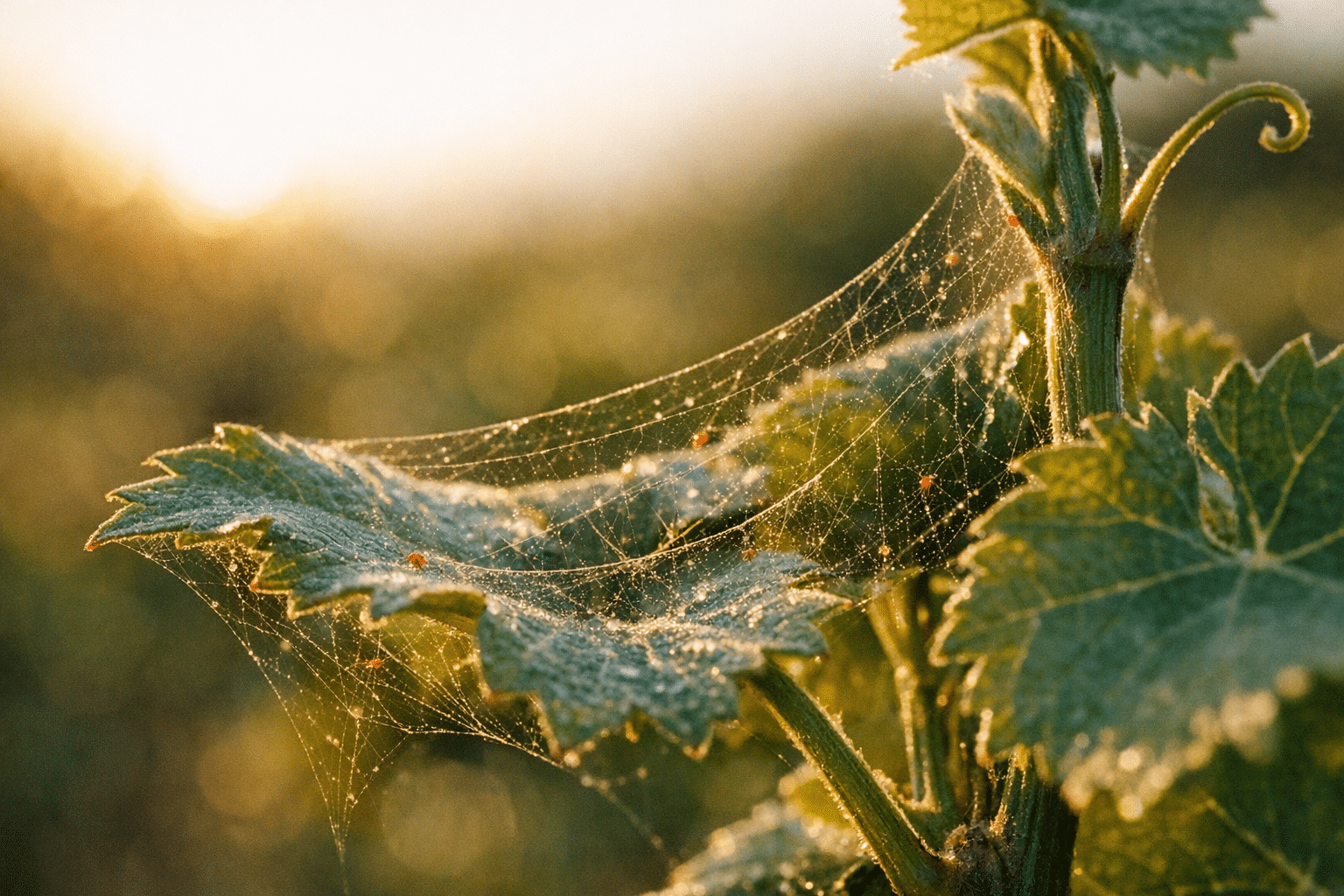
If the red speck you saw was running across a wall, a windowsill or a sunny patio stone, you can relax. It is usually Balaustium murorum or a close relative, it doesn’t bite, and it isn’t a crop pest. If it was under a leaf, inside very fine webbing, with pale stippling on the leaf above, you are looking at Tetranychus urticae, the two-spotted spider mite, and that one does real damage.
They are two different animals that share a nickname. The mix-up costs people either way: some treat a wall, others shrug at an orchard.
How to tell them apart
| Wall mite | Plant-feeding spider mite | |
|---|---|---|
| Where you see it | walls, stones, sills, sunny patios | underside of leaves |
| Look | bright red, visible to the naked eye, runs fast | 0.5 mm, grayish green or yellowish with two dark spots; overwintering females turn orange |
| Webbing | none | yes, fine, between leaves |
| Damage | none to plants | pale stippling, bronzing, leaf drop |
| What to do | nothing | real control |
Webbing is the quickest test. The plant-feeding mite spins it, and you can see it against the light. The wall mite doesn’t. Crush a wall mite on fabric or a light surface and it leaves a red stain. That is its only nuisance, and it goes away if you leave it alone.
One note for orchard owners. On apple and other tree fruit, the “red mite” is often a different species, Panonychus ulmi, the European red mite: deep red, about 0.4 mm, overwintering as red eggs on twigs. The control steps below hold in general for all of them, but timing differs by species.
Why the plant mite is so stubborn
The cycle is short and tracks temperature. From egg to adult takes about 28 days at 60 °F and about 8 days at 82 °F. In very warm weather a generation can finish in under a week, which is why “there was nothing last week” is the standard complaint.
It likes hot, dusty conditions. Water-stressed plants are especially vulnerable. Anyone who has walked an orchard in July has seen it: the first trees to yellow are on the edge, next to the gravel road, where dust settles on the leaves.
It builds resistance. With so many generations a year, repeating one mode of action selects the survivors. There is also a side effect: broad-spectrum insecticides sprayed for other pests kill the natural predators, and the mites rebound harder.
The damage works like this: mites drain the leaf cells, the leaf stipples, then bronzes and can drop. On grapes and tree fruit that means less photosynthesis just when the fruit is sizing up.
Control for the plants that have them
Scout first, spray second. Count mobile mites on a fixed number of leaves, with a hand lens, checking the underside. Treatment thresholds are set by your state extension service for each crop, not by a universal rule.
Water and dust come first, and they are cheap. Where the crop allows it, misting the underside of leaves, even daily, keeps numbers down. Fewer passes that raise dust help too. Watch for fungal disease when you wet the canopy.
Predators keep working. In greenhouses and on vegetables, growers release Phytoseiulus persimilis, which finishes its life cycle faster than its prey: about 10 days against 18 at 68 °F. It works best at an average of at least 64 °F and humidity above 60%, and handles extreme heat poorly. A rule of thumb from UC IPM: one predator for every ten spider mites. In orchards the point is to avoid killing the predatory mites already there, which means skipping broad-spectrum insecticides. If you spray a miticide, wait out the label interval before releasing predators.
Miticides, when needed, get rotated. Rotate modes of action, not brand names. UC IPM advises against using the same mode of action more than twice a season on ornamentals, and most products need repeat applications. Use only products registered for that crop in your state, and follow the label.
Soaps, oils and sulfur have temperature limits. Don’t apply them to water-stressed plants or above roughly 90 °F, and don’t use sulfur within 30 days of an oil spray. Always read the label.
Go easy on nitrogen. Leaves rich in nitrogen favor mites. Generous spring feeding gets paid back in summer.
Scouting in practice
Do the same round every week, on the same plants, with the same hand lens. Turn the leaf over, look at the underside, count mobile mites, and note webbing and stippling too. One day’s number says little. The trend says a lot, because in hot weather a population that climbs steeply needs action sooner than one that holds steady. Always compare the result with your extension threshold, not with a gut feeling.
What about fall and winter?
When it gets cold, the mite changes color. Overwintering females turn orange or red and, in colder regions, hide under rough bark scales. That is why in November you can’t find the greenish summer mite and may think it has gone. It hasn’t gone; it is waiting. Summer is the season to watch, but if you had a bad outbreak, note where it was so you can recheck those plants first in spring.
The mistakes we see most
- Treating the wall and not looking at the leaves.
- Spraying by eye, without counting.
- Repeating the same product, or the same mode of action under another name.
- Using a broad-spectrum insecticide on another pest and finding the mites a month later.
- Applying sulfur or oil to plants already under stress, in the heat of the day.
Where reading the plant comes in
A trunk sensor doesn’t count mites. You do that with a hand lens, under the leaves.
But mites reach stressed plants first, and the plant signals early: sap flow drops days before the canopy shows anything. Knowing when a block is entering stress tells you when to check the underside of its leaves, instead of finding the problem after the damage is done.
The Plantvoice sensor reads sap flow and salinity inside the trunk continuously and turns them into a single call: irrigate now or wait. In orchards where it is in use, it has cut water by up to 40% while keeping quality. See how to detect water stress before symptoms appear and how the sap flow sensor works.
Frequently asked questions
Are the red mites on walls dangerous? No. The ones running over walls, stones and sunny sills don’t bite and don’t attack crops. Crushed, they leave a red stain. The harmful red spider mite lives under leaves, measures half a millimeter and spins very fine webbing.
How do I recognize the spider mite on plants? By the fine webbing between leaves and the pale stippling on the upper leaf surface. The mite is grayish green or yellowish with two dark spots, and you need a hand lens to see it. Females that overwinter turn orange.
Why do spider mites come back after treatment? Because in warm weather the cycle closes in under a week, and because broad-spectrum insecticides kill the natural predators too. Without them the population rebounds harder, often with individuals resistant to the mode of action you used.
How do you get rid of spider mites? Scout the underside of the leaves, cut dust and water stress, bring in predators and, only if needed, use registered miticides rotated by mode of action.
When do spider mites show up? In warm, dry spells, mostly in summer, and earlier on dusty plants and water-stressed ones. Leaves rich in nitrogen favor them.
Want to take away the conditions the mites thrive on? Talk to our agronomists, or ask for a trial of the Plantvoice sensor on your own plants.