Xylella has no cure. An infected plant is removed, and everything else in the defense comes down to keeping the insect that carries it, the meadow spittlebug, in check. In Europe the bacterium is confined to limited areas, with Puglia in southern Italy as the worst case: in May 2026 the regional authority redrew its map after 11 of 13 olive trees sampled at Mola di Bari tested positive, in an area that had been clear. On November 4, farmers’ association Coldiretti Puglia reported 83 more infected olive trees in the Gargano (Cagnano Varano), bringing that outbreak to 413 since its first find in autumn 2025. If you grow olives, almonds, grapes or stone fruit, or sell Mediterranean ornamentals, here is what the rules and the biology say.
Where Xylella fastidiosa is in 2026
The bacterium was first reported in the EU on olive trees in Puglia in October 2013. It has since been found in France, Spain and Portugal, but official surveys confirm it only in limited areas. EPPO’s distribution database, last updated on October 20, 2026, lists it as present with restricted distribution in Italy and Portugal, in the Balearic Islands and in Corsica, and as eradicated in Germany. Poland and several other EU countries are listed as absent.
Science is moving too. At the close of its fifth European conference on Xylella, held in Mola di Bari in June 2026, EFSA said it will publish an updated pest risk assessment by the end of 2026, replacing its 2019 scientific opinion (EFSA news, June 25, 2026).
Outside Europe it is an old problem. Pierce’s disease of grapevine, caused by one subspecies, is widespread in the United States and has cost its wine industry heavily, and containing it takes sustained vector control.
In the EU, Implementing Regulation 2020/1201 sets the rules. When the bacterium is confirmed, the authority draws a demarcated area made of two parts:
- an infected zone, at least 50 meters around the infected plants;
- a buffer zone around it, at least 2.5 km wide where eradication is attempted.
Where eradication is no longer realistic, as in the Salento in southern Puglia, the infected zone moves to containment measures. Regulation 2024/2507 cut the strip where containment and annual surveys apply from 5 km to 2 km, to concentrate resources on finding infected plants.
Two official acts show how it looks on the ground in 2026. Puglia’s determination no. 82 of May 11, 2026 reports that 40,379 plants were sampled in the delimited area in 2025 and early 2026, and 96 tested positive. It also adds point outbreaks at Mola di Bari and Noci, treated by eradication. Determination no. 9 of February 2, 2026 created a new delimited area at Valenzano, where 16 plants (olive and almond) tested positive out of 352 samples.
Puglia has three subspecies of the bacterium, and foci in every province.
How to recognize it on an olive tree
The bacterium colonizes the xylem, the vessels that carry water, and blocks them. The plant shows symptoms of drought even in wet soil.
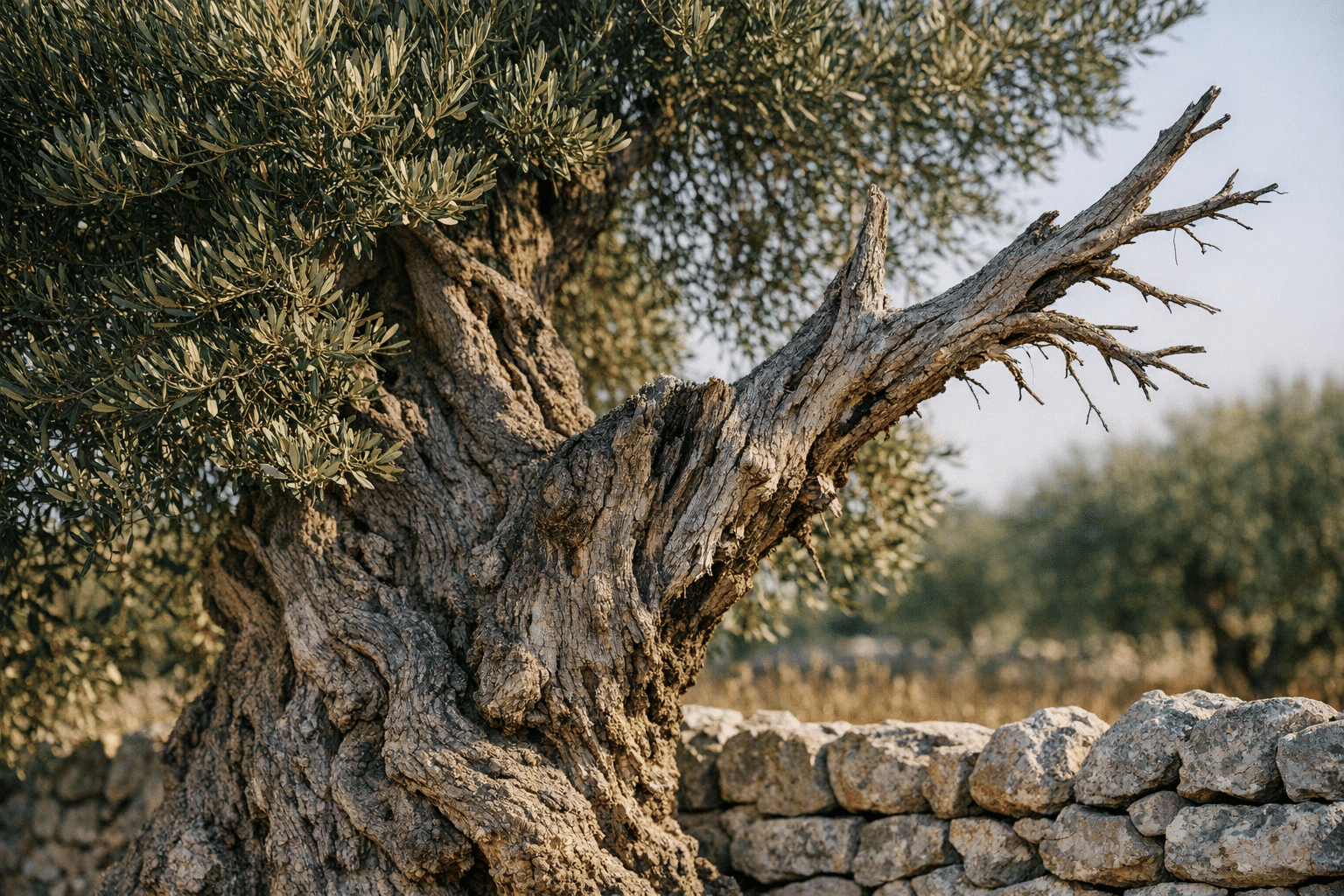
- Yellowing and wilting of leaves on a few branches, usually in the upper canopy.
- The branches dry out, with leaves curled along the midrib that stay attached for a long time.
- The dieback spreads through the canopy. In susceptible cultivars a tree can be badly damaged within two to three years.
On almond, the typical sign is leaf scorch in summer on some branches. On ornamentals such as oleander, Lavandula dentata and polygala, it appears as leaf scorch and patchy dieback. Most infected host plants show no important symptoms at all and carry the bacterium silently, which is why surveys rely on sampling.
You cannot diagnose it by eye. Summer heat and water stress, winter frost or other wood fungi can cause the same symptoms. Only an official laboratory test confirms it. If you find an isolated dry branch in a healthy orchard, report it to your national plant health service so it can sample the tree. In Puglia, a report is how the Mola di Bari outbreak was found.
The vector, month by month
Xylella travels with insects that feed on xylem sap. In Europe the main vector is the meadow spittlebug, Philaenus spumarius, according to EFSA.
- Spring: nymphs hatch and live on weeds under the trees, wrapped in white foam. They are healthy and barely mobile.
- From late April or so, depending on climate and altitude: they become winged adults and move into the canopy. There they pick up the bacterium from infected plants and stay infectious for life.
- October and November: adults lay eggs on the ground and die. The infection is not passed to the eggs.
That is why the one control with real agronomic sense is managing ground cover in spring, while the insect is still on the grass. In Puglia the region now requires shallow tillage or mowing of the ground cover across the whole region, in a window of a few weeks. In 2026 the window ran from March 25 to April 30 below 200 meters of altitude and from April 10 to May 15 above it, with grass cut to 10 cm at most. Adult-stage insecticide treatments are mandatory in municipalities inside the delimited areas, with products labeled for the purpose.
What the rules require
At EU level, for a new focus under eradication:
- plants of the specified species within 50 meters of the infected plant are removed, with priority for the infected ones;
- the vector is treated beforehand, and the plants are destroyed on site.
In a containment zone, infected plants are removed right after official confirmation, or before the next vector flight season if the find is made outside it. New productive plantings of specified plants are restricted (Article 18 of Regulation 2020/1201), with listed exceptions. Specified plants move with a plant passport carrying a traceability code (Regulation 2020/1770, amended by 2024/2507).
Deadlines, compensation and penalties are set by each national or regional authority. In Puglia, an owner has 3 days to say whether they will remove the trees themselves or ask the regional forestry agency, then 10 days to do it, and refusal brings forced removal at the owner’s cost and an administrative penalty. Your country may differ, so check with your plant health service.
Tolerant olive varieties: what is known
Puglia’s action plan authorizes replanting olives with Leccino, Lecciana, Leccio del Corno and Favolosa (FS-17) in the infected zone outside the containment strip, because they proved resistant or tolerant to subspecies pauca, strain ST53. In field studies, bacterial populations in Leccino and FS-17 were 10 to 100 times lower than in susceptible cultivars, with mild symptoms.
Tolerant does not mean immune. The trees can still carry the bacterium. And the trials involve pauca ST53, so the results do not carry over automatically to other subspecies, such as the multiplex found on almond in Alicante, Spain.
Where reading the plant fits in
Many Xylella symptoms look like those of a plant that is not getting the water it needs. The Plantvoice sensor does not diagnose Xylella. A laboratory does that. What it does is rule out the plainest explanation, so that a heat spell is not mistaken for disease.
The sensor continuously reads sap flow and salinity inside the trunk. To see how stress is read before it shows, we wrote about how to detect it before symptoms and how the sap flow sensor works.
Frequently asked questions
Can Xylella be cured? No. There is no method to cure an infected plant and no registered product that cures it. Defense rests on removing infected plants and controlling the insect vector.
What are the symptoms of Xylella on olive? Yellowing and wilting on some branches, then dieback with curled leaves that stay attached. The symptoms are not specific, and only an official laboratory test confirms the disease.
What spreads Xylella? Insects that feed on plant sap. In Europe the main one is the meadow spittlebug, Philaenus spumarius. Nymphs are healthy, and adults become infected by feeding on infected plants.
Where is Xylella in Europe? According to EPPO, in limited areas of Italy, Portugal, the Balearic Islands and Corsica, and it has been eradicated in Germany. Poland has no record.
Which olive trees resist Xylella? Leccino, Lecciana, Leccio del Corno and Favolosa (FS-17) are considered resistant or tolerant to subspecies pauca ST53 in Italy. They can still host the bacterium, in much smaller amounts.
Want to know what applies to your orchard before spring? Talk to our agronomists to set up your monitoring calendar, or ask for a trial of the Plantvoice sensor on your own plants.