Powdery mildew is a fungal disease that coats leaves, shoots and fruit with a white, flour-like growth. Unlike downy mildew, it does not need free water to infect, so it can thrive in warm, dry weather. On grapevine the pathogen is Erysiphe necator. On courgette, melon and cucumber it is mostly Podosphaera xanthii. The plan is to keep the canopy open, remove what carries the disease through the winter, and protect plants early, because powdery mildew is easier to prevent than to cure.
Autumn matters here too. In the vineyard the fungus survives the winter as mycelium inside buds and as small black fruiting bodies in the bark, and on garden crops it carries over on plants and weeds. This guide covers what powdery mildew looks like on grapevine and cucurbits, the weather that favours it, the field measures that help and where sulphur and other fungicides fit. If the problem is fuzzy growth on the underside of the leaf rather than white powder on top, read our guide to downy mildew.
Powdery mildew on grapevine
Early infections on grape leaves are easy to miss. The ARSAC technical sheet says that infections from ascospores leave only a slight chlorotic spot on the leaf. Later, shoots can become covered in mycelium, and some shoots stay stunted with a stiff, flag-like tip, which is why growers call them flag shoots.
On clusters the disease is more obvious after fruit set. The same sheet warns that heavy attacks on clusters can occur even when the leaves show no symptoms, so look at the bunches, not only at the foliage. Sensitivity is highest before flowering, and it stays high after flowering until veraison.
Powdery mildew on cucurbits
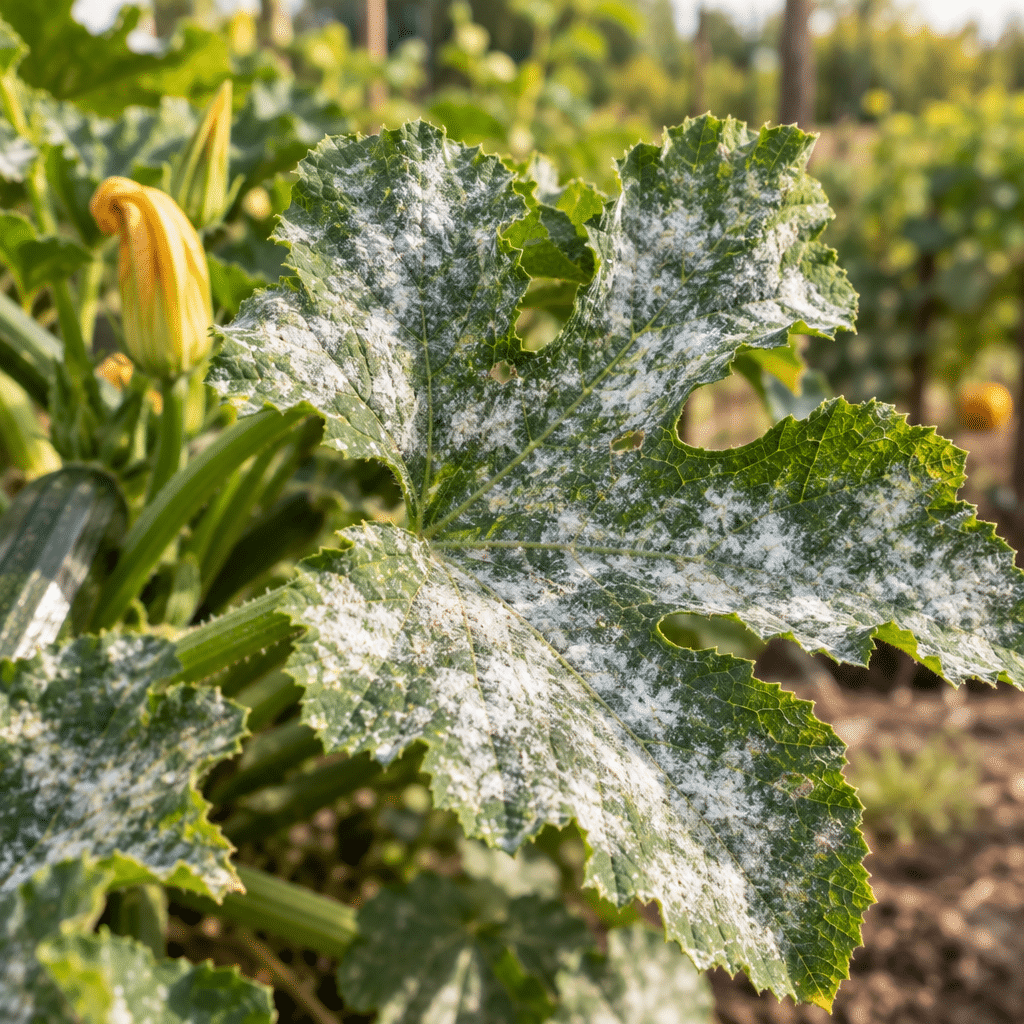
The Emilia-Romagna plant health service calls powdery mildew the most frequent disease of cucurbits, caused mainly by Podosphaera xanthii and Golovinomyces cichoracearum. It starts as small, round white spots, often on the underside of the leaf, which spread to both sides and take on a powdery look. Affected leaves turn yellow, curl and dry out, and in melon the disease can alter the aroma of the fruit.
General extension guidance from Penn State describes the typical picture: a flour-like coating, usually on the upper leaf surface, with tiny black specks appearing later. Those specks are the resting structures that help the fungus survive.
What favours powdery mildew
Powdery mildew likes warm, dry weather. Penn State gives a range of 60 to 80 °F (about 16 to 27 °C), and growth slows above 90 °F (about 32 °C). On grapevine, ARSAC reports development between 6 and 35 °C, and says the fungus can proliferate even when relative humidity is below 50%. Temperatures above 32 to 35 °C inhibit the germination of the spores, and above 40 °C they die.
On cucurbits the range is 10 to 35 °C, with an optimum around 26 °C. Spores can germinate at low humidity, although higher humidity favours them. In Emilia-Romagna the most intense infections are generally in June and July in warm, dry seasons. In the vineyard, ARSAC lists ventilated hilly sites, susceptible varieties and years that alternate rain and dry spells as risk factors.
Where it spends the winter
On grapevine, the fungus overwinters as mycelium in the buds and as cleistothecia, small black fruiting bodies, in the bark; these form from late summer into autumn. In spring the cleistothecia release ascospores during or after rain above 2.5 mm, at a mean temperature around 10 °C. On garden crops, Penn State says powdery mildew overwinters as mycelium on crops and weeds.
So autumn clean-up helps. Remove infected material and dispose of it by burning or in sealed bags rather than composting, and clear plant debris in the fall. Pull out weeds that can host the fungus too.
What to do in the field
Use resistant varieties when you can. The Emilia-Romagna service notes that resistant cucurbit varieties are valid, but that many commercial ones do not have the resistance. Keep air moving: stake or prune to open the canopy, remove suckers, and avoid overcrowding and overwatering.
Water at the base with drip or soaker lines. If overhead watering cannot be avoided, do it early in the morning. Sterilise tools between infected and healthy plants.
Sulphur and other fungicides
We name categories, not products or doses. Check the current rules of your regional plant health service and the product label before you spray.
Sulphur is the classic option. ARSAC explains that it acts through sublimation above 18 to 20 °C, while finer sulphurs work at 10 to 12 °C. It becomes phytotoxic above 32 °C and has only a weak curative action, so it works best as protection. On cucurbits the Emilia-Romagna service rates sulphur as good but advises care on cucumber because of phytotoxicity, especially under protection.
In the vineyard, conventional programmes start at one to two unfolded leaves, with shoots about 5 cm long, in high-risk areas, and at separated flower buds in lower-risk areas. Organic growers can use sulphur from two to three leaves, then wettable sulphur by pressure, along with the biocontrol fungus Ampelomyces quisqualis, Bacillus pumilus and resistance inducers such as cerevisane and COS-OGA. Resistance is a real issue: Emilia-Romagna reports problems with strobilurins in Italy, and a fungicide group that is not always effective. Alternate active ingredients, and respect the seasonal limits in your region.
On cucurbits, preventive programmes are preferable, although treatment can start after the first symptoms because the disease is not highly virulent. In the garden, Penn State lists neem oil, copper and phosphorus-based fungicides. They are not guaranteed to eliminate the disease and work best as repeated preventive applications. Neem oil kills insects it touches, including bees, so apply it in the evening. We explain the details in our guide to neem oil.
Powdery or downy mildew?
The two are often confused. White powder on top of the leaf points to powdery mildew, fuzzy growth underneath points to downy mildew.
| Powdery mildew | Downy mildew | |
|---|---|---|
| Where it shows | Usually on the upper side, as white spots | Fuzzy growth on the underside, small yellow dots on the upper side |
| What it looks like | Flour dusted on the leaf; black specks can form later | Fluffy mats, usually bluish, from white to grey to purple |
| Weather | Warm and dry; needs no free water to infect | Relative humidity above 85%, cool temperatures |
| Winter | As mycelium in buds and on crops and weeds, and as black fruiting bodies in bark | Some species overwinter in soil and plant debris in mild climates |
On cucurbits the two can follow each other. Emilia-Romagna notes that from August, or earlier in humid seasons, downy mildew may prevail over powdery mildew.
FAQ
How do you recognise powdery mildew? Look for a white, flour-like coating, usually on the upper leaf surface. On grapevine, early leaf infections show only a slight pale spot, while shoots and clusters become covered in mycelium; on cucurbits, small round white spots often start on the underside.
Is powdery mildew the same as downy mildew? No. Powdery mildew looks like flour on the upper side and does not need free water to infect. Downy mildew grows on the underside of the leaf and favours humid, cool weather.
What weather favours powdery mildew? Warm, dry weather. Extension guidance gives 60 to 80 °F (about 16 to 27 °C), and growth slows above 90 °F (about 32 °C). Grapevine data show it can develop even below 50% relative humidity.
Does sulphur cure powdery mildew? Sulphur has only a weak curative action and works best as protection, applied early. It is phytotoxic above 32 °C, and on cucumber it needs care, especially under protection.
What should you do with infected leaves and plant debris? Remove them and dispose of them by burning or in sealed bags, without composting. Clear debris in the fall, because the fungus overwinters on crops, weeds and in the bark of vines.
Want a scouting and spray-timing routine for your crop? Talk to our agronomists to set it up before next season, or ask for a trial of the Plantvoice sensor on your own plants.