Honeydew gets four steps, in this order: find out which insect produced it, wash it off early, hit the soft-bodied insects that remain with insecticidal soap, then deal with the ants. The soap goes on in soft water, at roughly 1 to 2% on the labels of registered products, early in the morning or in the evening, never in strong sun.
If scale insects are behind it, the three common species and the treatment calendar are in the article on scale insects and mealybugs. This one covers what that article doesn’t: the working sequence for honeydew and soap, with doses and limits.
1. Recognize honeydew
Honeydew is a sugary liquid that some sap-sucking insects excrete as they feed. Three signs:
- glossy, sticky leaves, with small drops on pots, patio furniture or the car parked underneath;
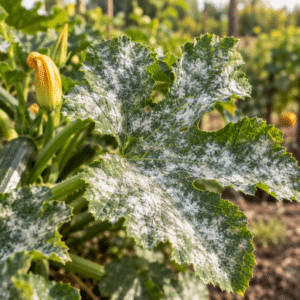
- a black film that rubs off like soot: sooty mold, a group of fungi that live on the sugar, not on the plant;
- ants running up and down the trunk.
Sooty mold is not a disease and doesn’t penetrate plant tissue. It does cover the leaf and cut the light reaching it, and with it photosynthesis.
2. Find out who produced it
Honeydew is the symptom. Soap without a diagnosis solves half the problem. The usual culprits:
| Insect | Where | How to tell |
|---|---|---|
| Aphids | shoot tips, buds, undersides of young leaves | small green, black or grey colonies with white cast skins |
| Whiteflies | leaf undersides, on citrus, vegetables, ornamentals | a cloud of white insects when you shake the plant |
| Psyllids | pear, boxwood, bay | flattened nymphs on the shoots |
| Cottony and soft scales | twigs, leaf axils, citrus, oleander | white cottony tufts or glossy brown domes |
Hard-shelled armored scales produce little honeydew. If those are all you have, the film comes from somewhere else.
Turn over a few sticky leaves and look at the underside. If you find nothing, look higher: honeydew drips from the leaves above.
3. Wash it off, and do it early
The plant protection service of Emilia-Romagna recommends washing honeydew off in the morning. On pear psylla the effect goes beyond cleaning: without honeydew the young stages are exposed to solar radiation and die in greater numbers.
Timing matters too. University extension sources agree that washing before sooty mold sets helps, and that once the black layer is thick it does little, because the fungus isn’t destroyed. In practice:
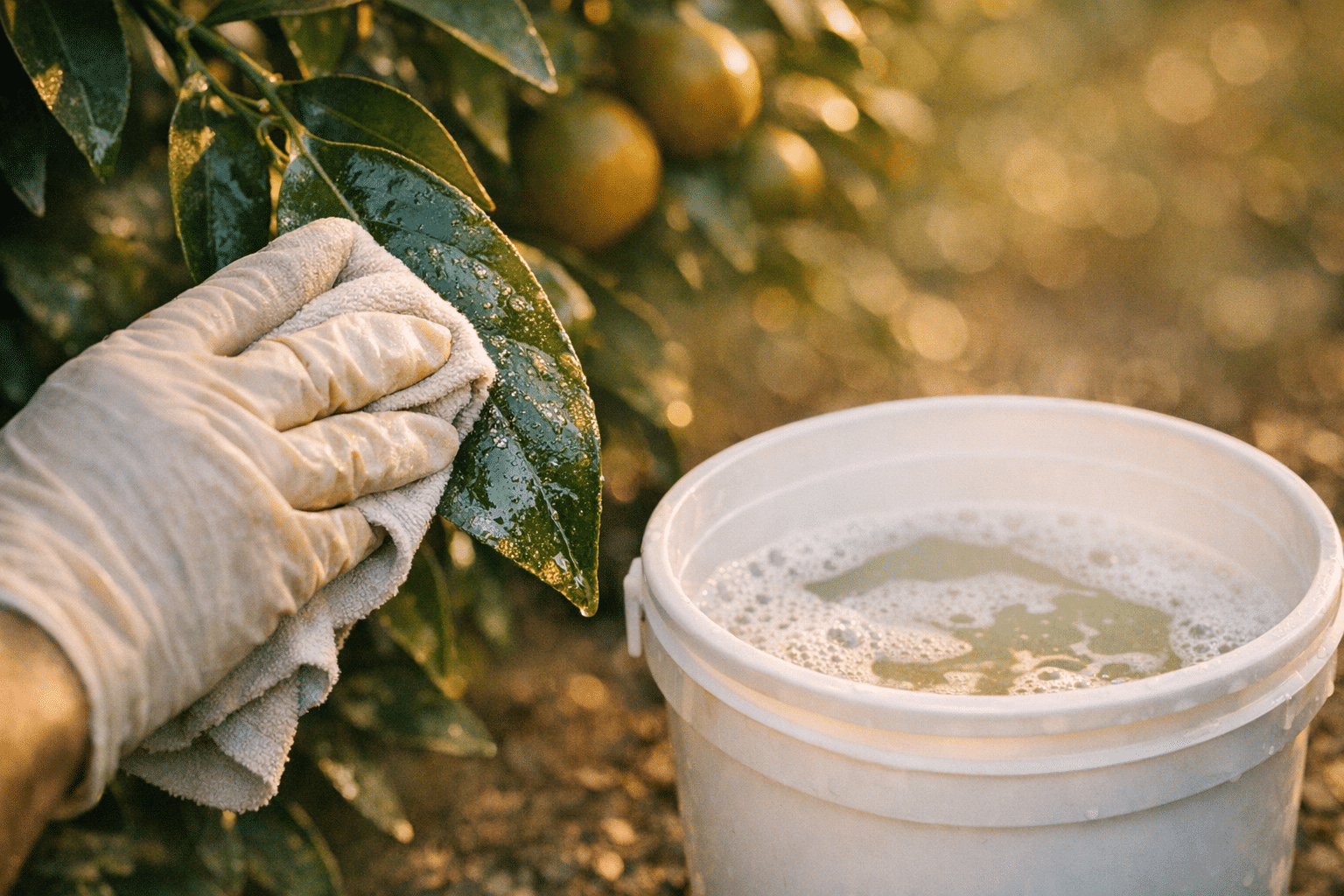
- small plants and houseplants: a cloth with soapy water, leaf by leaf;
- hedges and trees: a hose or sprayer at low to medium pressure, with a wide spray;
- then look at what is left on the leaves, because that is the soap’s job.
4. Insecticidal soap: what it does
Insecticidal soaps are potassium salts of fatty acids, according to UConn Extension. Emilia-Romagna’s plant protection service adds that soaps made from palm oil are ineffective against pests, so read the composition.
It works on contact, in two ways. It dissolves the waxes of the cuticle of soft-bodied insects (aphids, psyllids, whiteflies, scale crawlers, mealybugs, spider mites) and disables them, and it dissolves honeydew, which is why it is used against sooty mold.
Once dry it does nothing and breaks down. So spray until the foliage drips, undersides included, and repeat: the regional sheet gives about seven days between applications. It doesn’t work on eggs or on hard-bodied insects such as beetles. It spares beneficials: the same sources say predators can be released a few hours later, once the foliage is dry.
5. Dose and preparation
The dose depends on the product, and the label rules. As a reference, University of Florida (UF/IFAS) writes that registered insecticidal soaps usually call for 1 to 2% soap in water, and warns that homemade mixes vary widely and often include ingredients that can burn the plant. Don’t raise the dose without testing on a few leaves first.
Three precautions matter more than the dose:
- Soft water. Calcium, iron and magnesium bind the fatty acids and make the soap less effective and harsher on plants (UConn). The regional sheet sets the limit at 300 ppm: with very hard water, use rainwater.
- Dissolve it first in a little warm water, top up to the final volume and use the mix right away.
- Soap made for plants, not dish detergent. UConn notes a higher risk of injury with dishwashing soaps and detergents not labeled as pesticides.
Don’t mix it with copper, calcium, iron, zinc or magnesium products, foliar fertilizers or chelating agents.
6. When and where not to use it
- Sun and heat. Early morning or evening is better. Above about 90°F (32°C), UConn advises against spraying.
- Stressed plants: dry, freshly transplanted or with tender new growth. They burn first.
- Bloom. Labels of registered products forbid treatment during flowering, and open blooms are among the most delicate parts.
- Greenhouses and high humidity. If the spray dries slowly, the product is harsher.
- Sensitive species. The Italian regional service lists some cucumber varieties, poinsettia, schefflera, gardenia and azalea, mostly on the flower. Extension sheets add delicate ferns, palms, succulents, Japanese maple, horse chestnut and bleeding heart.
The same test works for every plant: treat two or three leaves, then wait 24 hours. If no spots or dark edges appear, treat the rest.
7. Ants and neem oil
Ants collect the honeydew and so defend the insects that produce it from predators. While they keep climbing the trunk, the infestation rebuilds; a sticky band around the trunk cuts the route (UC IPM).
Soap acts briefly and by contact. Neem oil follows a different logic and has a different legal status, both covered in the article on neem oil. If you use both, they are two treatments with two labels: not in the same tank.
The regulatory picture
Rules differ by country, and the label is the legal document wherever you are. What can be said across the board:
- Active substance. Potassium salts of fatty acids (“fatty acids C7 to C20”) are an approved active substance in the EU. The approval expires on December 1, 2026, and in July 2026 EFSA listed the renewal as still under evaluation. Until that changes, registered products remain usable under their labels; check that a new product is still on sale before you buy it. In Great Britain the same substance is listed as approved until August 31, 2029 (PPDB).
- Organic production in the EU. Annex I of Regulation (EU) 2021/1165 admits fatty acids for all uses except as a herbicide.
- Registered products. In the EU a plant protection product can’t be placed on the market or used without authorization in the member state (Article 28 of Regulation 1107/2009). A soap sold as a cleaner can’t claim insecticidal action.
- Outside the EU. Which products are allowed on food crops or in organic production depends on the national register. Check yours.
Where reading the plant comes in
A sensor in the trunk can’t see honeydew: you see it when you turn a leaf over.
Stressed plants are also the ones that tolerate soap worst. Sap flow shifts days before the canopy shows anything, and that helps you decide whether to treat today or wait. The Plantvoice sensor reads sap flow and salinity inside the trunk continuously and turns them into a single indication: irrigate now or wait. See detecting stress before the symptoms appear and how the sap flow sensor works.
Frequently asked questions
How do you use insecticidal soap on plants? Dissolve it in a little warm water, dilute to the label dose (often 1 to 2% for registered insecticidal soaps) and spray until the whole plant is wet, undersides included, early in the morning or in the evening. Repeat after 7 days, because once dry it no longer works.
Does insecticidal soap remove honeydew? Yes, it dissolves it and lifts it off the leaf, which is why it helps against sooty mold. But if you don’t treat the insects that produce it, the honeydew comes back: identify the insect first, then wash.
Does insecticidal soap burn leaves? It can, in strong sun, above about 90°F (32°C), on stressed plants or on sensitive species such as azalea, gardenia or poinsettia. Test on two or three leaves and wait 24 hours.
Can you use insecticidal soap in organic growing? In the EU, Annex I of Regulation (EU) 2021/1165 admits fatty acids for all uses except as a herbicide. Also check that the specific product is registered and that its label allows it.
Can dish soap replace insecticidal soap? No. Detergents aren’t formulated for plants and raise the risk of injury. Soaps made from palm oil are also ineffective against pests.
Want to reach next season with plants that don’t invite aphids? Talk to our agronomists, or ask for a trial of the Plantvoice sensor on your own plants.