Scale insects are killed at the crawler stage — the mobile juveniles — because the adult sits under a shield or a layer of wax that no product reliably penetrates. So everything depends on timing: winter wash at the end of winter against the overwintering forms, soft soap or oil in season when the crawlers are moving, and stronger products only where the threshold is genuinely exceeded.
The catch is that “scale” covers at least three different insects with different defences. These are the three you actually meet.
The three you meet, and how to tell them apart
| Mealybug | Armoured scale | Soft scale (half a peppercorn) | |
|---|---|---|---|
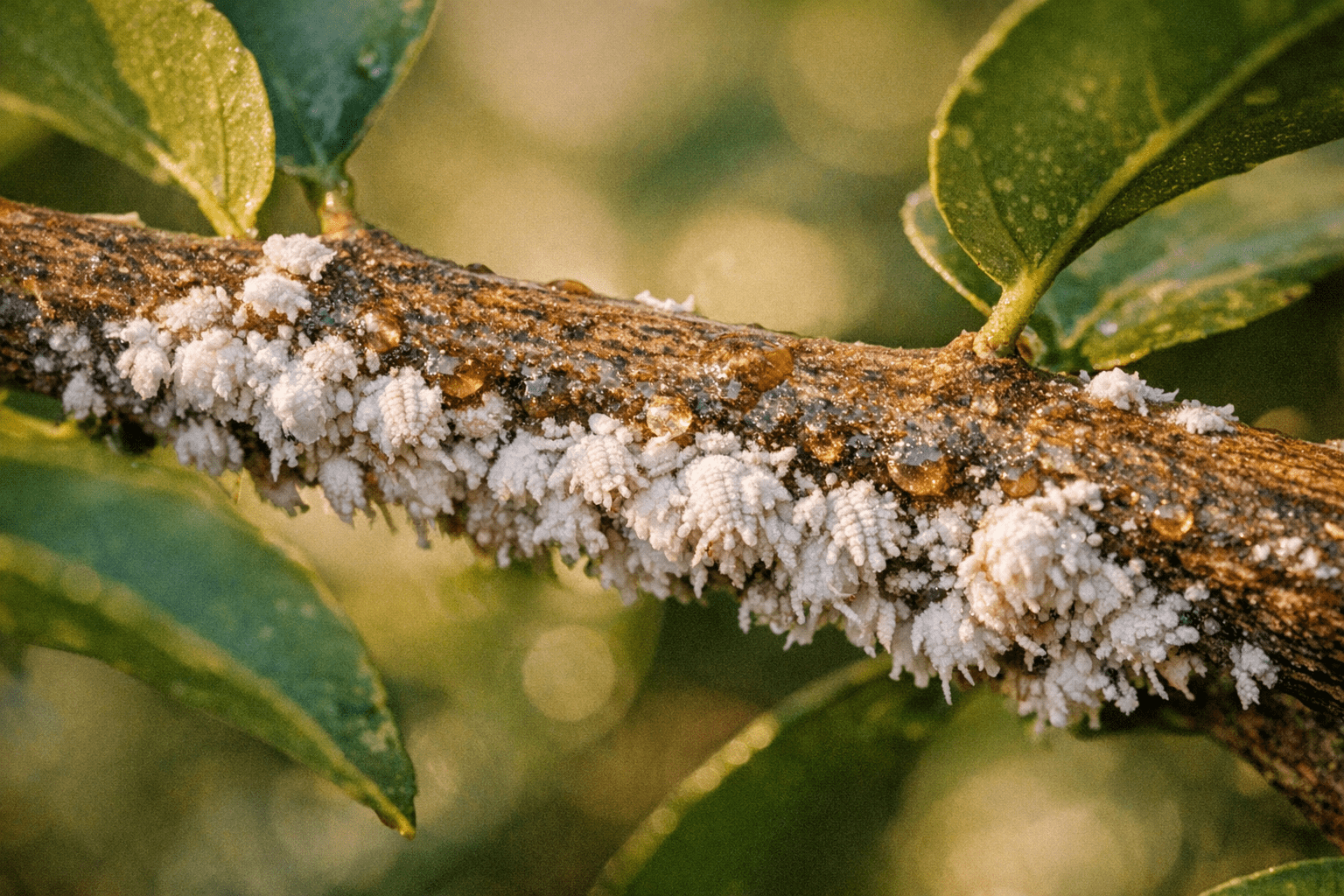
| Look | white waxy tufts, mobile insect underneath | hard grey or brown shield, immobile | glossy brown dome |
| Where it sits | leaf axils, undersides of branches, collar | branches and trunk, upper leaf surface | young shoots and leaf underside |
| Does it lift off? | yes, with a fingernail, and the insect is under it | no, it stays stuck | it lifts off and leaves the insect behind |
| Honeydew | a lot | little | a lot |
| Typical plants | citrus, houseplants, orchids, vine | olive, fruit trees, ornamentals | citrus, oleander, bay |
The test that settles it in ten seconds: press with a fingernail. If an orange or reddish smear appears under the shield, that is the insect and it is alive. If it is dry and empty, you are looking at the remains of an old infestation and you are about to treat for nothing.
The life cycle, which is the whole secret
All three share the same structure: the adult female is fixed and protected, the crawlers are mobile and naked.
- Late winter: overwintering forms on the branches. This is the moment for a winter wash, which works by smothering and reaches the adults too because it coats them.
- Late spring: crawlers hatch and disperse. This is the window in which any product works.
- Summer: overlapping generations, so juveniles and adults together. Several passes needed.
- Autumn: the overwintering forms build up, and it starts again.
On a fully formed adult, soap and oil wet the shield and run off. That is the reason for “I treated and they are still there”: they were there before too, dead or alive, and they do not fall off by themselves.
What to do, in order
1. Mechanically, wherever you can. On houseplants and small pot plants, a cloth with water and soft soap run along the branches removes most of it. On potted citrus it is often the only intervention needed.
2. Winter wash at the end of winter. On bare or dormant plants, above 5 °C and with no frost forecast in the following 48 hours. It smothers the overwintering forms and gives the best ratio of result to side effect.
3. Soft soap in season. On the crawlers, every seven to ten days, wetting under the branches and into the leaf axils. It has no persistence: repetition counts, and thorough wetting counts.
4. Neem oil. Useful on crawlers, useless on protected adults. Same rules as any oil: evening, never above 30 °C.
5. Stronger products. Only above threshold and only in the crawler window. Outside it, it is expenditure with no effect and one certain side effect: it removes the natural enemies that were working for you.
6. Natural enemies. Cryptolaemus montrouzieri against mealybug, ladybirds and parasitoid wasps against the others. With selective products they stay on, and they are the guard that keeps working between treatments.
Honeydew and sooty mould: the symptom you notice first
It is almost never the scale you spot first. It is the stickiness on the leaves, and the black film growing on it.
Honeydew is the sugary liquid the insect excretes as it feeds. Sooty mould is a fungus that lives on it and does not attack the plant: it covers it, and by cutting out light it cuts photosynthesis.
The order of operations, which is where nearly everyone goes wrong:
- First work out what is producing it. Scale, aphids and whitefly all produce honeydew. Treat the wrong pest and the honeydew comes back.
- Then wash. Water and soft soap, to remove honeydew and sooty mould. Treat without washing and the product sits on the film instead of reaching the insect.
- Then treat, in the crawler window.
- Then deal with the ants. Ants farm and defend honeydew-producing colonies: as long as they are climbing the trunk, the infestation rebuilds. A sticky band on the trunk breaks the chain.
Where reading the plant comes in
A sensor in the trunk does not count scale insects. You find those by looking under the branches.
But the colonies show up first on stressed plants, and it is a regularity anyone who prunes will have noticed. A plant that is struggling produces more concentrated sap, and its defence against a sap-sucking insect is weaker. The plant says so first: sap flow changes days before the canopy shows anything.
The Plantvoice sensor reads sap flow and sap salinity inside the trunk continuously and turns those numbers into one instruction: irrigate now, or wait. See detecting stress before the symptoms appear and how the sap flow sensor works.
Frequently asked questions
How do I identify scale insects? By the shape of the covering: white cottony tufts with a mobile insect underneath, a hard immobile shield, or a glossy brown dome. Press with a fingernail: if an orange smear appears underneath, the insect is alive; if it is dry and empty, it is the residue of an old infestation.
When is the right time to treat scale insects? Late spring, when the crawlers hatch and move: it is the only stage at which the insects are naked and mobile and products actually work. At the end of winter, a winter wash is used against the overwintering forms.
Is soft soap enough against scale insects? On the crawlers, yes, if you repeat every seven to ten days and wet under the branches and into the leaf axils. On adults protected by a shield, no: the product runs off without reaching the insect.
Why are the leaves still sticky after treatment? Because honeydew already produced does not disappear on its own. It has to be washed off with water and soft soap; otherwise sooty mould keeps growing on it and the next treatment sits on the film instead of reaching the insect.
What do ants have to do with scale insects? Ants feed on the honeydew and in exchange defend the colonies from their natural enemies. As long as they climb the trunk the infestation rebuilds: a sticky band on the trunk breaks the chain.
Want to go into the season with plants that do not invite pests? Talk to our agronomists, or ask for a Plantvoice sensor trial on your own plants.
HERO_PROMPT: Ultra-realistic editorial photograph of white cottony mealybug colonies clustered along the underside of a lemon tree branch, glossy citrus leaves around. Extreme detail on the cottony wax and the sticky honeydew sheen: visible texture, natural imperfections, true-to-life colour. Shot on a full-frame DSLR, 100mm macro lens, shallow depth of field with clean bokeh, soft natural daylight with golden-hour warmth, high dynamic range, realistic shadows and highlights, subtle analogue film grain (Kodak Portra 400), cinematic colour grading, elegant editorial composition, agricultural documentary aesthetic, photorealistic, ultra-detailed, 8K, masterpiece quality. No text, no watermark, no logo, no captions, no cartoon, no 3D render, no illustration, no AI-glossy plastic look, no oversaturated colours, no unrealistic insect anatomy, no human faces in focus, no branded products or readable labels.