Downy mildew is a disease of leaves, shoots and fruit caused by oomycetes, fungus-like organisms that depend on wet weather. On grapevine the culprit is Plasmopara viticola. On tomato and potato a close relative, Phytophthora infestans, causes late blight, which Italian growers call peronospora del pomodoro. In both crops the plan is the same: remove what carries the disease through the winter, keep foliage dry, and protect plants before an infection period, because treatments work mainly as protection.
Autumn is when next year’s outbreak gets prepared. In the vineyard, the winter spores of downy mildew form in August and stay in the fallen leaves, and tomato and potato late blight survives on leftover plants and on nightshade weeds. This guide covers what downy mildew looks like, the weather that triggers it, the field measures that help and where fungicides fit. If you are not sure whether you are dealing with downy mildew or the white powder of powdery mildew, go to the comparison table below or read our guide to powdery mildew.
How to recognise downy mildew on grapevine
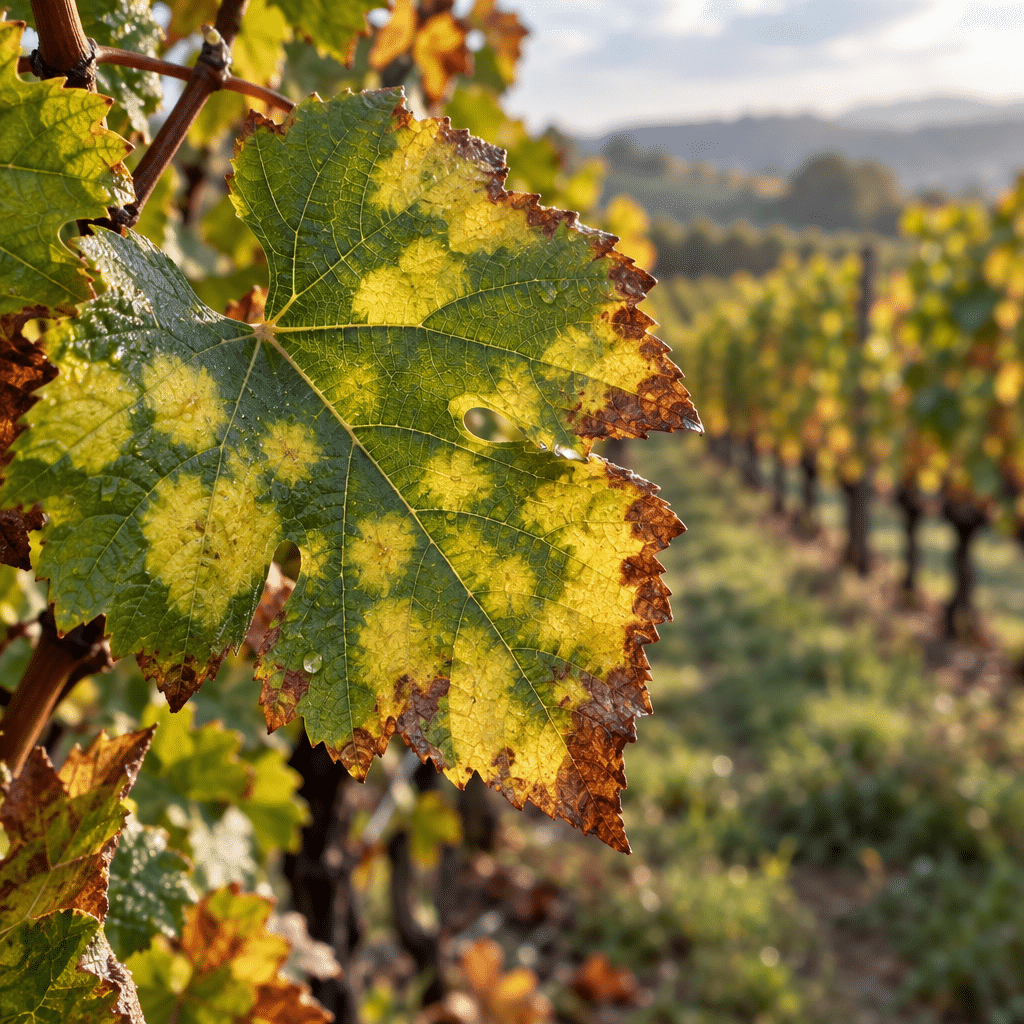
On the upper side of a grape leaf, downy mildew first shows as yellow, translucent patches known as oil spots. They later die and turn brown. On the underside, opposite each spot, a whitish felt of growth forms. Late infections in midsummer look different: small yellowish patches, mostly close to the veins, that give the leaf a mosaic look.
Young shoots look scalded and brown, and young canes can twist, especially at the tip. An early attack on the flower clusters, from before flowering to the end of it, makes the end of the cluster bend like a hook, turn brown and then grow a whitish down. After fruit set, the berries get covered with whitish growth and the cluster stem looks scalded, often curved into an S. These descriptions follow the Lazio region plant protection sheet.
Downy mildew on tomato and potato: late blight
On tomato leaves, late blight starts as small water-soaked areas that quickly grow into purple-brown, oily-looking blotches, according to the University of California IPM programme. Rings of grey-white growth can form on the underside, and the disease moves on to the leaf stalks and young stems. Italian technical guidance describes irregular, discoloured leaf spots that turn brown, and translucent patches on green fruit that spread and change from olive green to brown.
Infected fruit usually stays firm unless other rot organisms move in. Symptoms often begin on the fruit shoulders, because spores land from above. The University of California gives a useful benchmark: when humidity is above 90% and the average temperature is between 60 and 78 °F (about 16 to 26 °C), infection takes about 10 hours. Wind carries the spores to neighbouring plants.
What triggers an infection
On grapevine, the spores germinate only when there is a film of water on the leaves, and that water also lets them move. Spring oil spots are typical of infections that happen with high humidity and a mean temperature that is not very high. For years growers used the “three tens” rule as an early warning: a mean temperature around 10 °C over 24 hours, shoots at least 10 cm long, and at least 10 mm of rain in the previous one or two days. The Lazio sheet calls it only a rough guide and now largely outdated, so treat it as a prompt to go and look at your vines, not as a spray trigger.
General extension guidance from Penn State says downy mildew is favoured by relative humidity above 85% and cool temperatures of 58 to 78 °F (about 14 to 26 °C). New spores can appear as soon as four days after infection, with seven to ten days more typical, so the disease can multiply quickly through repeated wet spells.
Where it spends the winter
On grapevine the pathogen survives winter as oospores in fallen leaves; they form in August. In spring, when conditions allow, they germinate and release the zoospores that start the first infections. On tomato and potato, late blight overwinters in potatoes, tomatoes and hairy nightshade, and possibly in the soil, according to the University of California.
This is why autumn clean-up pays. Remove infected material and dispose of it by burning or in sealed bags rather than composting, and clear plant debris in the fall, as the Penn State extension advises. In tomato and potato fields the Californian guidance adds removing volunteer plants and nightshades, and discing the field in the fall to eliminate the winter reservoir.
What to do in the field
Start with resistant varieties where downy mildew shows up regularly, and check transplants for late blight before planting. Keep air moving: stake or prune to open the canopy, avoid overcrowding, overwatering and poorly drained soil, and remove suckers, since new growth is the most susceptible.
Avoid sprinkler irrigation if you can, because it favours the disease. Drip or soaker lines keep foliage dry; if overhead watering cannot be avoided, water early in the morning. Sterilise tools between infected and healthy plants.
Fungicides: protection first
We name categories, not products or doses. Check the current rules of your regional plant health service and the product label before you spray.
In the vineyard, preventive cover is the core of the strategy, and growers are advised to alternate active ingredients to avoid resistance. The Lazio sheet, which follows the region’s integrated production rules for 2024, suggests treating before flowering on the basis of rain forecasts, treating cautiously from pre-flowering to fruit set even without oil spots, and later adjusting to disease presence and weather. Copper is capped under those rules at 28 kg over seven years and, on average, no more than 4 kg per hectare per year. Organic growers have copper salts and, during sporulation, sweet orange essential oil.
On tomato, Italian guidance says to treat as soon as the weather turns favourable for infection and to repeat every 6 to 12 days, depending on the weather and how long the product lasts. The University of California advises applying a protectant before the disease develops, repeating at regular intervals with thorough coverage once an outbreak starts, and rotating modes of action instead of repeating the same one.
Tuscany’s plant health service has added a forecasting model for tomato, the potential infection index, to its Agroambiente.info platform. The service describes this kind of model as a proven way to rationalise defence and keep treatments to the minimum. The page does not publish the thresholds behind the index.
In the garden, Penn State lists neem oil, copper and phosphorus-based fungicides. They are not guaranteed to eliminate the disease and work best as repeated preventive applications. Copper can harm some plants, and neem oil kills insects it touches, including bees, so apply it in the evening. We explain the details in our guide to neem oil.
Downy or powdery mildew?
The two are often confused, but the treatment logic differs. Check the leaf: fuzzy growth underneath points to downy mildew, flour on top points to powdery mildew.
| Downy mildew | Powdery mildew | |
|---|---|---|
| Where it shows | Fuzzy growth on the underside of the leaf, small yellow dots on the upper side | Usually on the upper side, as white spots |
| What it looks like | Fluffy mats, usually bluish, from white to grey to purple | Flour dusted on the leaf; black specks can form later |
| Weather | Relative humidity above 85%, cool temperatures | Warm and dry climate; needs no free water to infect |
| Winter | Some species overwinter in soil and plant debris in mild climates | As mycelium on crops and weeds |
On cucurbits such as courgette, melon and cucumber the two can follow each other. The Emilia-Romagna plant health service notes that powdery mildew is the most frequent cucurbit disease, with the most intense infections generally in June and July in hot, dry seasons, while from August, or earlier in very humid seasons, downy mildew can take over.
FAQ
How do you recognise downy mildew on grapevine? Look for yellow, translucent oil spots on the upper side of the leaf that later turn brown, with a whitish felt on the underside. On clusters, the tip bends like a hook and grows a whitish down.
Is downy mildew the same as powdery mildew? No. Downy mildew grows on the underside of the leaf and likes humid, cool weather. Powdery mildew looks like flour on the upper side and does not need free water to infect.
What weather triggers downy mildew? Wet leaves and high humidity. Extension guidance gives relative humidity above 85% and cool temperatures; for tomato late blight, humidity above 90% with an average of 60 to 78 °F (about 16 to 26 °C) allows infection in about 10 hours.
Can you cure downy mildew once it shows? Treatments work mainly as protection. Regional guidance calls preventive cover treatments essential, and the University of California advises applying a protectant before the disease develops and repeating it at regular intervals once an outbreak starts.
What should you do with infected leaves and plant debris? Remove them and dispose of them by burning or in sealed bags, without composting. Clear debris in the fall, because the pathogen overwinters in it.
Want a scouting and spray-timing routine for your crop? Talk to our agronomists to set it up before next season, or ask for a trial of the Plantvoice sensor on your own plants.