
Irrigation is one of the most impactful technical decisions on a farm . The wrong choice results in wasted water, reduced yields, and management costs that accumulate season after season.
In this article, we compare the two most common systems in professional agricultural irrigation : sprinkler irrigation and drip irrigation . We’ll see how they work, where each has a real advantage, and what technical and agronomic variables should guide the decision.
How Sprinkler Irrigation Works
Sprinkler irrigation distributes water in the form of droplets , simulating natural rainfall. The water is pushed under pressure through pipes to nozzles, which spread it in a defined radius above ground level.
Sprinkler systems differ in:
- Nozzle type : rotating (for large surfaces), fixed (for small areas or sensitive crops), impact sprinkler (high flow rate)
- Operating pressure : typically between 1.5 and 4 bar, with flow rates ranging from 0.5 to over 5 m³/h per nozzle
- Range : from 5 to over 30 metres in self-propelled systems such as pivots and reels.
For large areas , the most common open-field systems are central pivots and self-propelled reels . The pivot is the dominant system in large monocultures on a global scale (USA, Argentina, Eastern Europe) and in Italy it is especially widespread in the Po Valley for corn and sugar beet , but it is not the prevalent system in Italian cereal cultivation in the broader sense. The reel is instead used on irregular plots or where investment in fixed systems is not economically justified.
The practical advantages of sprinkling include relatively simple installation, less technical knowledge required for day-to-day management, and adaptability to any field shape without changing the crop layout.
How drip irrigation works
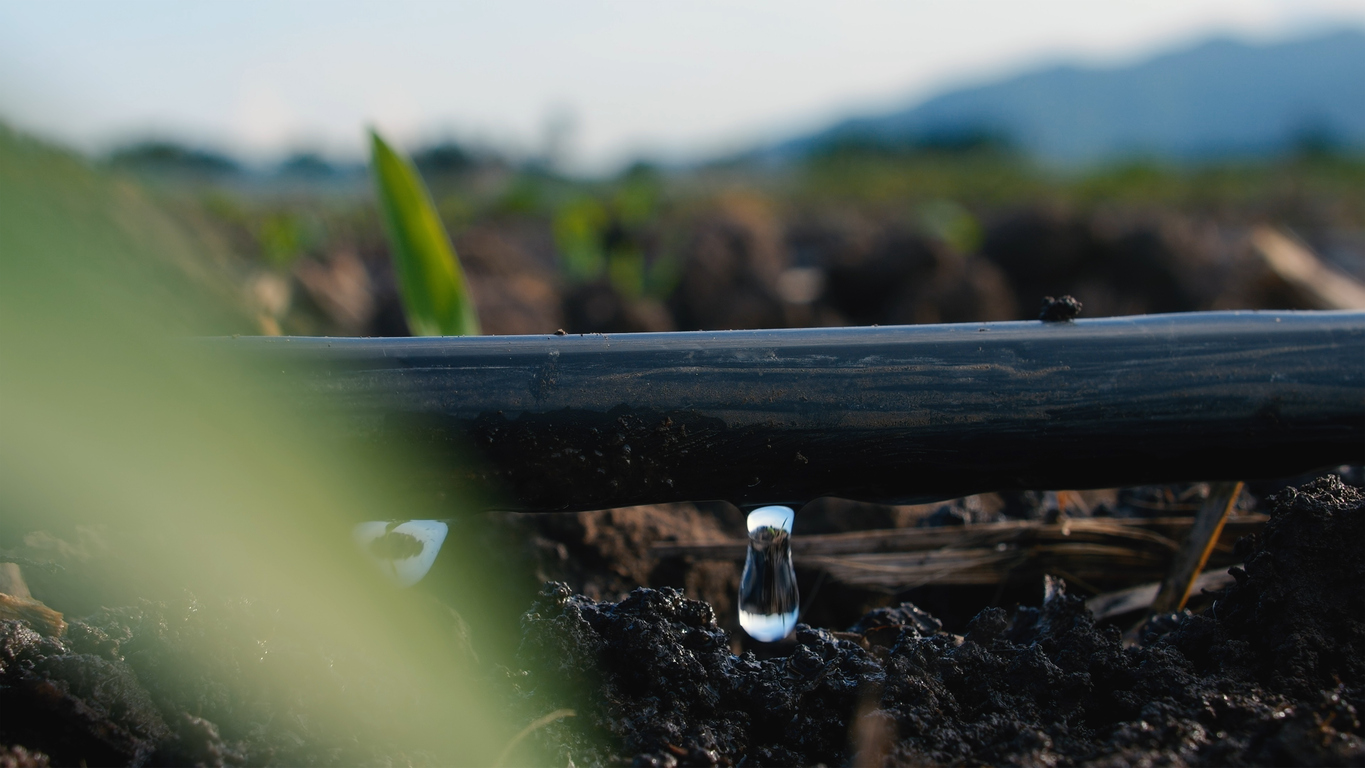
Drip irrigation (or microirrigation ) delivers water directly to the root system through emitters positioned along drip lines. Operating pressure is low : between 0.5 and 2 bar, compared to the 2-4 bar typical of sprinkler systems. This translates into lower energy consumption and greater manageability on plots with limited elevation changes. The flow rate per emitter varies between 1 and 8 liters/hour: the most common value in viticulture and fruit growing is 4 liters/hour, while on sandy soils, higher flow rates are preferred to ensure adequate lateral wetting.
The system can be:
- Above ground : the wings are positioned along the row, suitable for row fruit trees and vegetables.
- Buried (SDI) : Pipes are buried 15-40 cm, reducing evaporation and making them invisible to mechanical operations.
- Micro-sprinklers : hybrid variant with low-flow nozzles, used in fruit growing and in some hilly situations.
Furthermore, drippers can be self-compensating (constant flow rate in a variable pressure range, useful on uneven terrain) or non- self-compensating (more economical, suitable for flat terrain with short lines).
Water efficiency comparison: what the data says
The difference in efficiency between the two systems is not marginal . Drip irrigation achieves a water use efficiency of 85-95 %, while sprinkling typically stands at 70-80% , with peaks worsening in windy conditions or high temperatures.
In practical terms, water savings compared to sprinkler irrigation can reach 30-50% per equivalent crop , depending on the type of soil, climate and phenological stage managed.
| Parameter | Drip irrigation | Sprinkler irrigation |
| Average water efficiency | 85-95% | 70-80% |
| Evaporation losses | Low (water on the ground) | Elevate (drops in the air) |
| Wind impact | Negligible | Significant (> 20% above 3 m/s) |
| Uniformity of distribution | High (CU> 90%) | Variable (CU 70-85%) |
| Weed control | Good (wetting on the row) | Poor (entire surface) |
| Risk of leaf diseases | Bass | Medium-high |
| Fertigation adaptability | Excellent | Limited |
| Annual maintenance | Media (filters, drippers) | Low-medium |
| Slope adaptability | High (with self-compensating) | Average |
Weed Control: Drip vs. Sprinkler
With drip irrigation , water reaches only the root zone of the crop. The areas between the rows remain dry, passively and continuously reducing weed germination , without additional intervention costs.
With sprinkler irrigation, the entire field surface is watered , including areas not occupied by the crop. The result is higher weed pressure, with a direct impact on the costs of chemical or mechanical weed control . In crops where weed control is expensive (vegetables, strawberries, young vines), this factor is part of the overall economic calculation of the irrigation system.
Which system for which crop
The choice is never absolute: it depends on the crop, the phenological stage, the soil structure and the company’s objectives.
| Culture | Recommended system | Technical notes |
| (Table) vine | Drop | Where used, the drop prevents wetting of the bunch, reducing the risk of Botrytis and pre-harvest rot. |
| Short-cycle vegetables | Sprinkling or drop | Sprinkling during germination by direct sowing; dripping during advanced vegetative stage |
| Corn | Sprinkling (pivot) | Pivot in large flat surfaces, roll in medium-sized plots |
| Grain | Sprinkling | Fixed systems often not economically justified |
| Tomato | Drop | Reduces the incidence of Botrytis and Phytophthora |
| Strawberry | Drop | Leaf wetness is incompatible with production |
| Citrus fruits | Drop | Efficiency on deep-rooted perennial crops |
| Olive tree | Drop | Targeted interventions, reduced seasonal water consumption |
| Lawn / Turf | Sprinkling | Leaf wetness is functional to the crop |
| Minor cereals | Sprinkling or no fixed system | Profitability per hectare often does not justify the investment |

The risk of leaf diseases: an underestimated factor
Water remaining on foliage creates favorable conditions for the development of fungal pathogens . In sensitive crops such as grapes, tomatoes, strawberries, and some vegetables, sprinkler irrigation increases the risk of:
- Gray mold : It develops at relative humidity above 85% and temperatures between 15 and 25°C. In viticulture, it is one of the most feared pre-harvest pathogens, where wetting the bunches in the weeks preceding the harvest can compromise the entire production.
- Downy mildew : the secondary cycle depends directly on the presence of free water on the leaves.
- Powdery mildew : it can be partially inhibited by direct wetting, but agronomic and chemical management remains complex and dependent on other environmental factors.
The timing of irrigation also has an impact: sprinkling in the evening or at night prolongs the permanence of free water on the leaves. Morning irrigation reduces the problem , but does not eliminate it. Drip irrigation , by not wetting the foliage, removes this variable from the entire pest management system.
Fertigation: Why Drip Irrigation Changes the Rules
Fertigation involves applying dissolved nutrients directly to the irrigation water. It’s technically possible with both systems, but the results are very different .
With drip irrigation :
- Nutrients are deposited directly into the active root zone .
- The efficiency of use increases measurably , reducing losses due to leaching into the aquifer.
- It is possible to split nitrogen fertilization into several applications during the season, adapting it to the actual needs of each phenological phase.
With sprinkling :
- Nutrient distribution is less precise and more subject to soil variability.
- The risk of leaching is higher , especially on sandy soils with low retention capacity.
- Wetting the leaves with concentrated fertilizer solutions can cause leaf burn during the hottest hours of the day.
For highly profitable crops, drip fertigation allows for nitrogen inputs reduced by 20-40% compared to conventional techniques, for the same yield.
Costs: A realistic 10-year analysis
The initial cost of drip irrigation is higher than sprinkling , but the comparison must be made over the entire useful life of the system: over 20 years for fixed polyethylene systems, while seasonal drip lines represent a recurring annual cost to be included in the management plan.
Things to consider when calculating your return on investment:
- Water savings: drip irrigation reduces consumption by 30-50% compared to sprinkling under equivalent conditions, with a direct impact on the consortium’s bill or on pumping energy.
- Reduced energy costs: Lower operating pressure results in lower pump consumption compared to high-pressure sprinkler systems.
- Reduction in pesticide treatments: the lower incidence of foliar diseases translates into fewer fungicide applications during the season.
- Increased yield or quality: documented in viticulture, tomato and intensive horticultural crops.
For extensive crops with low profitability per hectare (cereals, forage), sprinkler irrigation remains the most economically justifiable system. For high-value, intensive crops , the return on investment for drip irrigation depends on the crop, the farm environment, and the management of the system over time.
When irrigation is not enough: the problem of timing
Climate change is changing these considerations: traditionally dry-climate crops such as vines and olives increasingly require irrigation support, especially in Southern Italy, where summer heat loads exceed historical tolerances.
The question always remains the same, regardless of the system chosen: when to irrigate?
Most systems, regardless of the system, are managed empirically, based on evapotranspiration models or soil moisture sensors that detect water availability in the soil, not the actual state of the plant. The soil may contain available water, but the plant may already be under stress if evapotranspiration demand exceeds root absorption capacity.
Plantvoice works on this point: monitoring the water potential in plant sap in real time, detecting water stress. A sap flow sensor that reads real-time plant water use turns that signal into a concrete answer to when to irrigate. An efficient irrigation system, combined with direct plant data, allows for timely intervention regardless of the system type chosen .
FAQ – Frequently Asked Questions about Agricultural Irrigation
Does drip irrigation work on all soils?
Yes, but it requires careful planning of the distances between drippers . On sandy soils , where capillarity is low, it is necessary to increase the number of emission points and reduce the hourly flow rate to ensure adequate lateral wetting. On clayey soils , where water conductivity is low, the risk is the formation of excess water on the surface with high-flow drippers.
In hot climates, is it advisable to use sprinkling to lower the temperature of the leaf microclimate?
Sprinkler irrigation has a real cooling effect through evapotranspiration , useful in specific situations such as frost protection or managing acute heat stress. However, this is not a sufficient argument for choosing sprinkling as the primary system, especially in crops susceptible to foliar diseases.
Is it possible to convert a sprinkler system to a drip system?
In some cases, yes, by reusing the main supply network . Drippers and drippers are added downstream, with a pressure reducer if necessary. Technical feasibility must be assessed on a case-by-case basis based on the type of pump, the available pressure in the system, and the geometry of the field.
The next step after choosing the system: knowing when to use it. You discover Plantvoice .