The Japanese beetle (Popillia japonica) is a priority quarantine pest in the European Union. It is established in northern Italy, with outbreaks in Switzerland and southern Germany, and the rules that follow from that status decide what you may move, what you must report and what you can do about it. In practice you manage it with three kinds of monitoring used together (traps, visual counts, soil samples) and with defense concentrated in the adult flight window, June to September.
If you farm or garden in the United States, this article is about the European side: the beetle has been a widespread pest in the eastern states for a long time, and your state extension service is the authority there. The biology and the field advice below still apply.
Two facts change decisions and rarely get mentioned. Regional authorities in Lombardy and Piedmont advise against pheromone traps in private gardens and vegetable plots, because the lure draws in more adults than the trap catches. And grapevines generally tolerate defoliation of up to 30% with no yield loss, according to the plant health service of the Swiss canton of Ticino, so not every chewed leaf calls for a spray.
If you read this in late October, the adults are done for the year. The work now is in the soil, where the larvae spend the winter.
How to recognize it
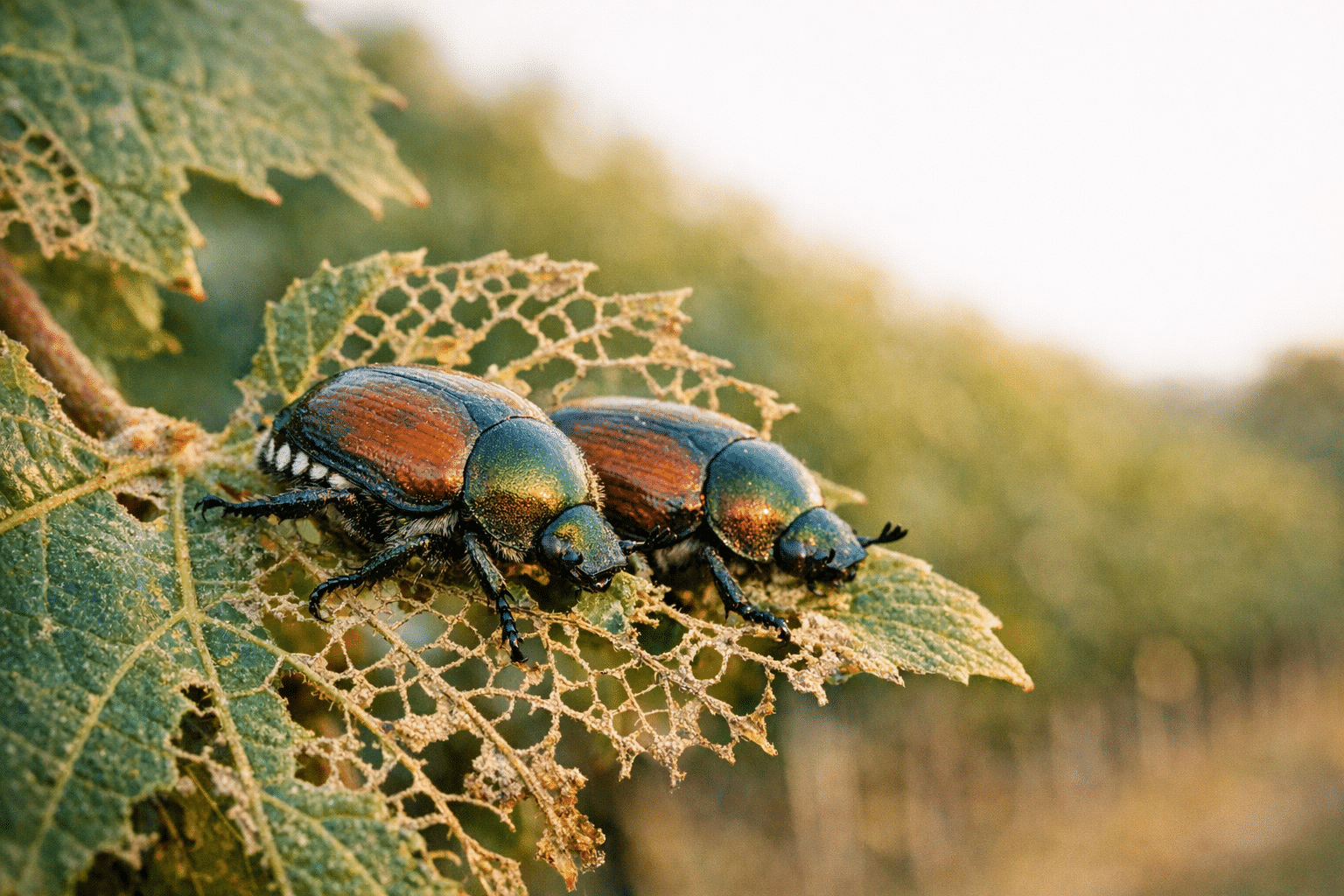
The adult is about a centimeter long, with a metallic green thorax and copper-colored wing covers. What removes any doubt is the row of white hair tufts along the abdomen: five on each side, plus two on the last segment. Similar-looking scarab beetles do not have that arrangement.
Adults eat the leaf tissue and leave the veins intact, so the leaf ends up like lace. The larvae live in the soil and eat grass roots. Preferred plants include grapevine, hazelnut, rose, linden, blueberry, bramble, cherry and soybean.
Where it is, and what the zones mean
The European outbreak began in 2014 in the Ticino river valley, between Piedmont and Lombardy in Italy, and has been spreading across the north of the country since. Elsewhere, delimited areas exist in Switzerland, and according to a July 2026 German plant-health notice there are outbreak areas in Baden-Württemberg (Freiburg, Lörrach) and in Hesse (Trebur).
Implementing Regulation (EU) 2023/1584 defines a delimited area in two parts. Outside it there is no third European zone, just the rest of the territory, which is surveyed.
| Zone | What it means | What it involves |
|---|---|---|
| Infested | officially confirmed presence, plus a strip of at least 3 km around it | containment measures, bans on moving soil and plant waste during the flight, conditions on outgoing plants |
| Buffer | a strip of at least 15 km beyond the infested zone | visual inspections and nursery checks |
| Outside the delimited area | no confirmed presence | official surveys, and any suspect find is reported |
In Italy the regions apply these boundaries to whole municipalities. Emilia-Romagna, with determination 6152 of 30 March 2026, enlarged its infested zone to nine municipalities in the province of Piacenza and extended the buffer zone to more municipalities in Piacenza and Parma. Lombardy updated its delimitation by decree on 25 November 2025, and Piedmont launched a 2026 plan with about 1,200 “attract and kill” traps.
Maps change every year. Check your own regional or national plant health service, not last season’s map.
What the rules require
- In an infested zone, during the adults’ flight, untreated plant waste may not leave the zone (except in closed vehicles, stored and composted indoors outside the area), and neither may topsoil or growing medium unless it has been treated.
- Nurseries in the delimited area need an official inspection at least once a year between June and August, at least two self-checks in the same period (including wild plants within ten meters of the boundary), and immediate notice to the plant health service if adults appear. Non-compliance can mean a block on plant movements.
- For plants leaving the area, the conditions in Regulation (EU) 2019/2072 apply.
- Everyone must report a suspected find to the plant health authority at once, with a photo, the date and the place. In Germany, for example, the notice states that every person has a duty to report.
Why garden traps backfire
Pheromone and floral-lure traps work: they catch beetles. The problem is their range. The lure pulls adults in from a distance, and some of them never enter the trap but settle on the vegetation around it. Over a large area, with a designed network, the balance is positive. In a garden or a vegetable plot it flips: you have brought in more insects than you have removed, and brought them to your own plants.
The traps in official plans are a different thing. In an infested zone they work as mass trapping, in numbers and positions chosen by the plant health service, and they should be neither moved nor tampered with.
If you have a garden or a small orchard, use no traps. Look over the plants, hand-pick adults early in the morning when they are slower, and report what you find.
Monitoring on a farm: three methods at once
- Traps. They tell you when adults arrive and how the curve climbs. On farms only, placed at the edges and away from the crops you want to protect.
- Visual counts. Count adults on a fixed number of plants, always the same ones, always at the same hour. It is the only figure that describes what is happening on your crop. Adults feed mostly when the air is between 21 and 35 °C and relative humidity is above 60%, and barely at all when it rains.
- Soil samples. Taken in grass and between the rows near the spots with the most catches, to count larvae. They tell you whether pressure will rise next year.
The life cycle is one generation a year: adults fly from June to September with a peak around mid-July; eggs are laid under the turf, usually in moist grassland; the larvae spend the winter 10 to 25 cm deep and move up in spring.
What to do in the field
During the adult window, June to September:
- insect netting where the crop allows it, closed before they arrive;
- with few adults, hand collection or localized knockdown treatments with products registered for the crop;
- chemical treatment only when the threshold is crossed, not on a calendar, and never while bees are flying.
In the soil, where next year is decided:
- against larvae, entomopathogenic fungi and nematodes, following the label conditions;
- avoid irrigating grass and the strips between rows in the summer weeks before egg-laying, because eggs need moist soil;
- shallow tillage in spring and autumn where the crop allows it.
In grapevines, the threshold that saves sprays is generally up to 30% of the final leaf area, with no effect on yield. It varies with vine vigor, variety and repeated damage over the years. Measure what is gone before you spray.
Where plant sensing comes in
A sensor in the trunk does not count beetles. Traps and your own eyes do that.
Summer water management, though, affects both egg-laying in the soil and fruit quality. Lowering moisture between the rows without pushing the tree into stress requires knowing how much water it is really using, not how much you gave it. The plant tells you sooner: sap flow drops days before the canopy shows it.
The Plantvoice sensor reads sap flow and salinity in the trunk continuously and turns them into one signal: irrigate now, or wait. See how to detect water stress before symptoms and how the sap flow sensor works.
Frequently asked questions
How do you recognize the Japanese beetle? An adult about 10 mm long with a metallic green thorax and copper wing covers, with five white hair tufts on each side of the abdomen plus two on the last segment. The damage is a skeletonized leaf with the veins intact.
Do traps work against the Japanese beetle? On farms, yes, if they sit at the edges and are planned as a network. In gardens and vegetable plots they are discouraged: the lure draws in more adults than the trap catches, and the extra ones settle on nearby plants.
How much defoliation can a grapevine tolerate? Generally up to 30% of the final leaf area with no yield loss, varying with vigor, variety and past damage.
What should I do if I find one outside a delimited area? Photograph it, note the date and place, and report it to your plant health service. It is a priority pest in the EU, and every report helps define the zones.
When are adult Japanese beetles flying in Europe? From June to September, with a peak around mid-July. The larvae develop in the soil, overwinter at 10 to 25 cm and move up in spring.
Want to manage water in the window that decides both the fruit and the eggs in the soil? Talk to our agronomists, or ask for a trial of the Plantvoice sensor on your own plants.