The pomegranate plant, also known as the ” pomegranate apple,” belongs to the Punicaceae family, which is native to the Middle East and Southwest Asia and spread to Italy at the time of the ancient Romans. Due to its ability to adapt to poor, saline, calcareous and water-scarce soils, it is currently cultivated on five continents.
The pomegranate is a hardy plant and is characterized by deciduous leaves with a bushy appearance. It can reach up to 5 meters in height, and the fruit it produces has various organoleptic properties. In addition, it has many benefits (nutritional, pharmacological, functional and cosmetic), which have led to a gradual increase in demand for the fresh fruit and its juice. So, Italy’s area under pomegranate cultivation has grown in regions such as Apulia, Sicily, Basilicata and Calabria. This expansion has led to the introduction of several diseases that are important to know about and prevent.
In this article we will look at the main diseases and pests that can affect pomegranate and some methods to combat them.
Pomegranate aphid: how to combat it
First and foremost, the pomegranateaphid is the best known and most peculiar pest affecting pomegranate. Its infestation occurs in early spring, when new shoots are forming and the temperature favors their spread. This pest can be recognized by its shiny green and yellowish color in juvenile form and black in adult form and is about 1.5 mm long. The aphid is very dangerous to pomegranate for three reasons:
- It produces a very abundant honeydew, which attracts various insects. It also causesasphyxiation of the plant, as the sun’s rays, reflected in the substance, cause burning.
- It has a trophic action, causing the plant to weaken.
- It causes discolored areas on the fruit that depreciate the produce for consumption.
Maximum colony number density is reached during the flowering period, that is, in the first half of May. With the arrival of summer, aphids remain on the plant, thanks to small, non-attracting, small colonies that live inside the shoots and manage to survive the warmer temperatures. In autumn, egg-laying activity resumes, resuming this cycle.
To combat aphid there are many species that can help in aphid control, for example, coccinellid beetles. However, these insects alone are not enough to limit infestations. In addition, professional methods such as insecticides, Cuban zeolite or resistance inducers can be used. In addition to this, nonprofessional methods such as potassium spring soap, white oil, neem oil, or self-made macerates made from nettle or garlic can be used to intervene.
Pomegranate moth
One of the most dangerous pomegranate pests is the pomegranate moth or pomegranate borer; it is a lepidopteran whose larvae feeds on various parts of the plant, including the fruit. The pyralid is one of the worst pests affecting pomegranate and it is important to recognize it to safeguard the planting.
It has two distinct forms:
- Larva: The larval state is the most feared because it directly damages the pomegranate. Larvae can reach 2 cm, are light brown mottled with white, and have a hairy appearance.
- Adult: When it becomes an adult, the larva transforms into a butterfly, which is also dangerous to the plant, as it can lay dozens of eggs and spread other larvae. It is a nocturnal butterfly about 1.5 cm long, very light brown in color with darker dots on its wings.
The larva attacks the plant for about a month, feeding especially on the seeds of the fruit. It also injures the skin, causing rot. Methods to defend against this pest include:
- Pyrethrum-based biological insecticides: both against the adult pest and the larvae is a nonselective insecticide, which can kill other insects as well.
-
Bacillus thuringiensis
: a natural bacterium that is used in agriculture, particularly in organic farming, as a biological insecticide. - Pheromone traps: for monitoring and capturing adult males can help reduce infestations and plan targeted interventions.
Metcalfa
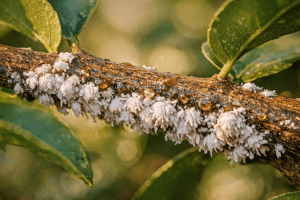
When discussing pomegranate pests, another name to keep in mind is metcalfa, an insect native to America that arrived in Italy in the 1970s. It is a 6 to 8 cm long, yellowish-colored pest that, when young, is white and covered with a waxy secretion. It feeds on plant parts through stings. It also smears the whole plant with wax and honeydew, causing it to
To combat this pest in nature there are vai predators that contain its presence. This is precisely why it is important to preserve the biodiversity of agroecosystems to encourage the presence of beneficial insects. An example of an insect that fights metcalfa in its juvenile stage is theHymenoptera Neodrynus typhlocybae. Again, some methods to combat this pest are the use of potassium spring soap or Cuban zeolite.
Citrus whitefly: a growing threat
The citrus whitefly, also known as the flaky aleurodid is another pest that affects the pomegranate plant, despite its misleading name. It attacks mainly in areas where citrus cultivation is widespread, such as in Sicily, where its reproduction is stimulated. This pest is similar to a gnat with a white and yellowish body, covered with a whitish waxy powder in the shape of a flake (hence the name “flaky”), about 2 mm long.
Citrus whitefly causes a main damage to pomegranate trees: leaves yellow and fall early, resulting in vegetative decay of the plant.
In addition to these problems, neanids cause even more damage. In fact, when present in large numbers on the underside of leaves, they produce copious amounts of honeydew, soiling the vegetation.
You can recognize the symptoms of this pest on leaves and shoots by certain signs such as:
- Color alterations or discolorations.
- Malformations or curling.
- Possible transmission of viruses and bacteria.
The most common methods of combating this pest are, again, soft soap, neem or white oil to remove the waxy secretion and safeguard plant health. In particular, interventions with white oils should be carried out in winter and target overwintering neanids. Another popular method for combating aphids is corroborant, a substitute for chemical insecticides and pesticides that does not cause harm to other plant beneficial insects, an example being soft soap. In addition, Cuban zeolite, resistance inducers and silicone resins are recommended. Finally, in nature, populations of the phytophage are controlled by entomophages such as: the coccinellid and the aphelinid hymenoptera.
Yellow rhodilwood
The yellow rhodilwood is another pest that can affect and damage pomegranates. In its juvenile form it is a yellow larva (hence the name) speckled with black, while the adult is a butterfly, also speckled with black.
It is the larvae that cause the damage to the plant, as they feed on the wood, digging tunnels on the crown of the pomegranate tree, attacking both shoots and branches. As a result, shoots dry up and branches break off, causing general stress to the plant. The affected branches as a result of the puncture collapse, because xylem flow is blocked.
Fighting yellowwood rootworm is very difficult because no biological product can penetrate the wood to the point of killing the larvae. Therefore, the best solutions are:
- Cut and burn the affected branches.
- Preserve natural predators such as the nematodes Neoaplectana carpocapsae and Neoaplectana feltiae.
- Install pheromone traps for massale trapping.
Alternaria: an invisible disease
Alternaria is one of the diseases that most affects pomegranate; in fact, it is also known as “black heart of pomegranate.” This disease spreads in spring, especially in rainy weather, and affects the fruit, which turns black in color. It is a fungus, which develops inside the pomegranate fruit and manifests itself as black, punctiform spots on the leaves, which subsequently fall off. These spots begin to occur early in the summer season and are small, round and irregular (1 to 4 mm). Each spot manifests a yellow-green halo surrounding a necrotic lesion.
As for the fruit, however, it is only possible to observe the symptoms on the inside. Externally, it is very difficult to distinguish infected fruits from healthy ones. For this reason, one of the greatest harms concerns the quality of the product at sale, as infected fruits are not always recognized and cannot be processed into juice.
Botrytis
Another pomegranate disease that deserves attention is borite or gray mold and is the main postharvest disease of the fruit. Wounds are the main entry route for this disease. Symptoms of the disease occur first on the residue and then inside the crown (upper part) as translucent brown spots.
The main causes may be:
- Plant stress conditions.
- Very humid environments during flowering and in the postharvest period.
- The part of the fruit known as the crown is particularly vulnerable, and flower remnants often remain inside, which can promote the development of the disease.
To prevent the plant from getting this disease, it is advisable to treat it preventively with copper products and zeolite.
Coniella Granati
: an emerging disease to be known
La
Coniella granati
is another disease of pomegranate: a creamy white fungus covered with abundant brown mycelium tending to black. Symptoms can be observed on the fruit at the post-harvest stage, as they form circular yellow/brown lesions and on the stems, with the appearance of cankers. These start at the crown and then spread along the entire fruit, which undergoes decay. Growth and spread of the fungus are favored by temperatures ranging from 25 to 30°C, and it spreads by contact between infected and healthy fruit.
This disease is not yet excessively widespread in Italy, except in southern countries, and because it is a new disease, a cure for the pathogen has not yet been found.
Prevention with Plantvoice
As highlighted earlier, pomegranate is a plant that can be affected by various diseases and pests. For this reason, it is crucial to invest in prevention and strategies that provide a complete picture of the health of one’s plants. In this way, the plant’s needs could be recognized in a timely manner, ensuring full crop productivity.
Plantvoice ‘s patented technology can make a difference to the health of plants as it monitors their condition, offering a diagnosis of the plant’s condition . It is a smart graft, about the size of a toothpick, that can analyze plant sap, almost as if it were an electrocardiogram. Through this innovation it is possible to collect a lot of information about the plant’s needs, noninvasively and constantly. All the data that the sensor collects is sent in real time to a platform with
Remedies against pomegranate diseases
As we have seen in this article, pomegranate cultivation is developing rapidly, so it is even more important to know the main remedies against diseases both during the flowering period and postharvest.
Some precautions that can be had to preserve the fruit are:
- Having good handling.
- Store the fruits properly.
- Proper irrigation
- Proper nitrogen fertilization.
Following these tips can prevent damage such as “cracking,” or splitting of the fruit, which increases the risk to cut infections.
Contact us for a consultation!